Investors and a founder explained why rare earths are critical, why China’s grip runs deeper than mining, and where the innovation opportunities lie.
Few regions feel the geopolitics of rare earth metals as directly as Asia-Pacific. China dominates processing, Japan felt the impact of a supply cutoff more than a decade ago, and the Pacific Ocean holds vast mineral deposits on its seabed. In 2025, China’s new export controls on rare earths and magnets left automakers around the world struggling to source supply.
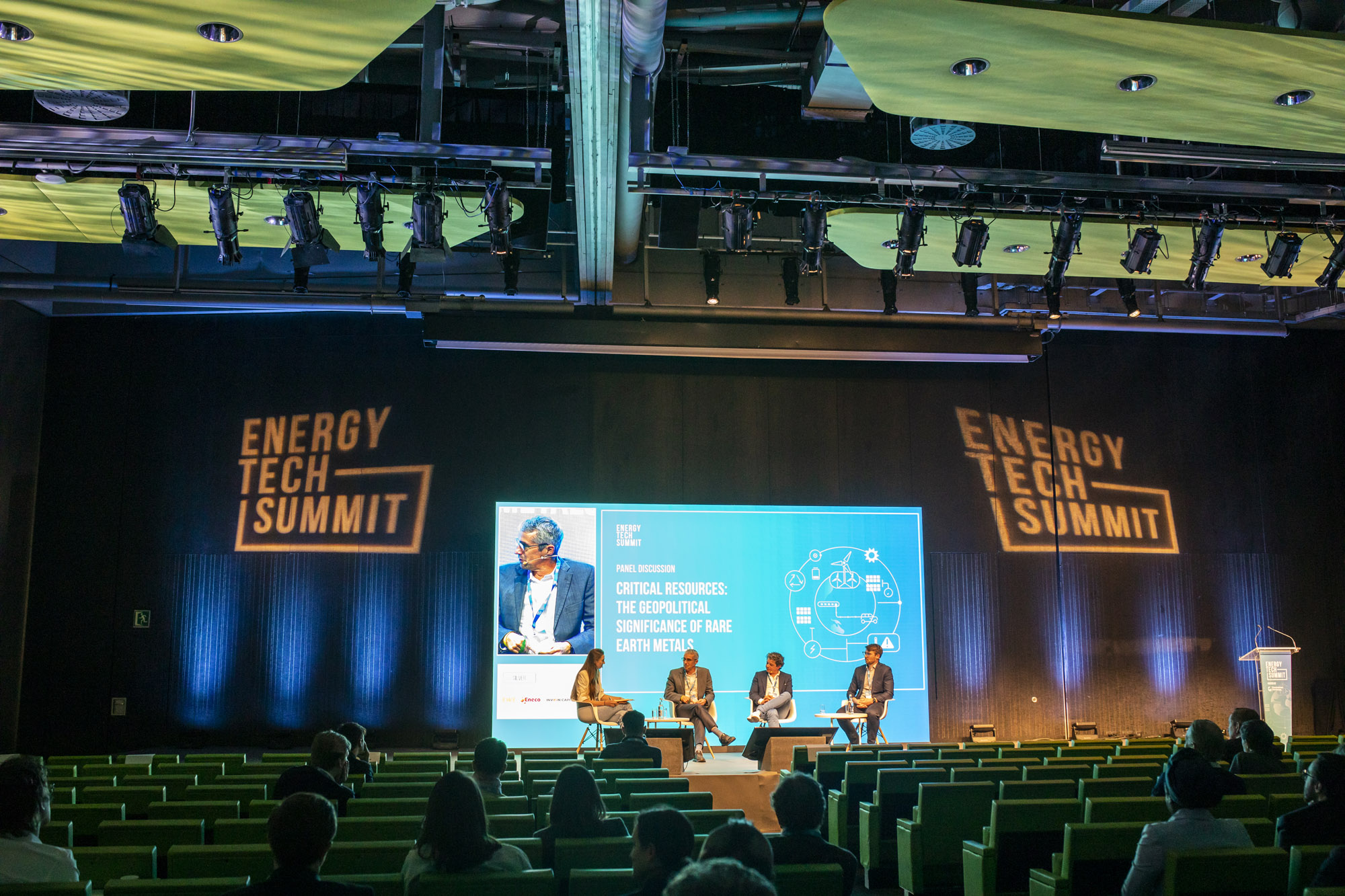
At Energy Tech Summit, a panel unpacked what that concentration means for industry, security and innovation. Beau-Anne Chilla, Partner at Anthemis, moderated the discussion. She was joined by Henk Both, Principal at Anzu Partners, Rutger van Raalten, Co-Founder and CEO of CarbonX, and Michael Granoff, Managing Partner of Maniv Mobility.
Three perspectives on critical materials
Both leads the energy transition vertical at Anzu Partners, an industrial technology investor backing materials science and manufacturing innovation. He holds a PhD in physical chemistry from Stanford.
Van Raalten co-invented CarbonX’s material, a drop-in alternative to graphite for batteries. CarbonX produces it at commercial scale in the US and Europe, helping automakers and battery makers reduce their dependence on the graphite supply chain.
Granoff runs Maniv Mobility, a seed-stage venture fund based in Tel Aviv that invests at the intersection of transportation and energy. He first became interested in the sector two decades ago because of oil’s geopolitical grip on transport. Today, the imbalances have shifted to minerals.
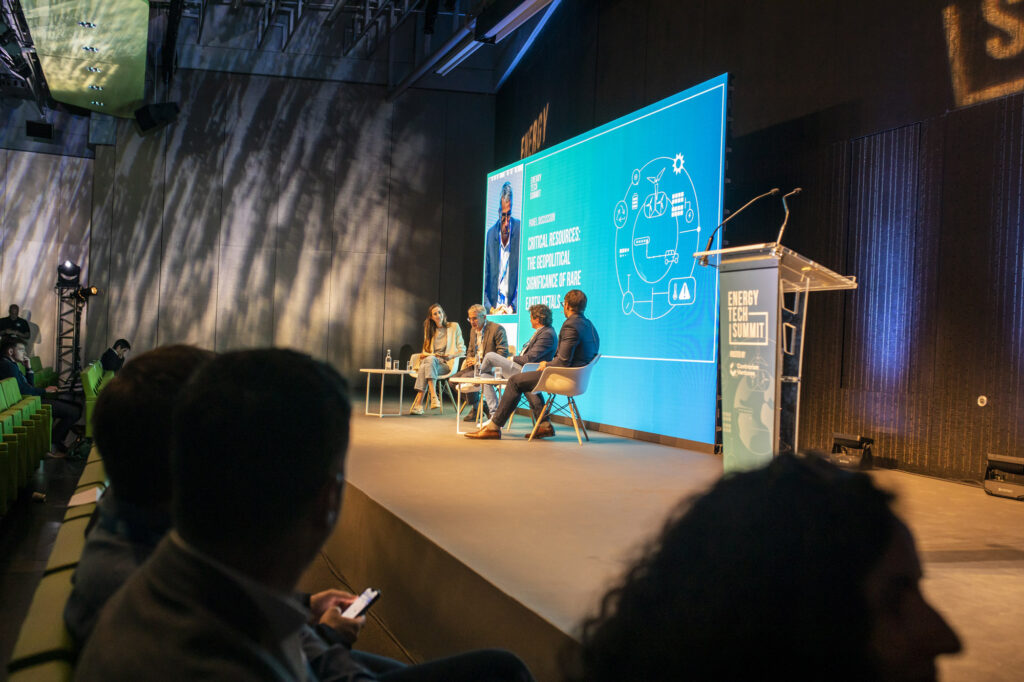
Panelists: Henk Both from Anzu Partners, Rutger Van Raalten from CarbonX, Michael Granoff from Maniv Mobility, and Beau-Anne Chilla from Anthemis uncover the global impact of these essential materials and discuss strategies to navigate the shifting landscape.
Are rare earths really rare?
Chilla opened with a simple question: are all critical materials metals? Both explained that rare earths are all metals, and what they share is magnetism. However, the wider category of critical materials includes battery inputs such as cobalt and graphite.
Van Raalten added an anecdote from a cell maker. We only talk about “critical” minerals, the manufacturer told him, because of China’s dominance. Otherwise, they would simply be minerals. In his view, criticality comes down to two factors: how much of a material is needed and how vulnerable its supply chain is.
Granoff offered a different angle. “Those things that are described as rare are rarely as rare as appear to be,” he said. Chilla called it “a cliffhanger” for the rest of the discussion.
Why rare earth metals are irreplaceable
For Granoff, the energy transition means moving from a carbon-based economy to a minerals-based one. That shift has its own costs. Quoting economist Thomas Sowell, he noted that “there are no solutions there are only tradeoffs.”
Both was specific about why the stakes are so high. Strong permanent magnets made with rare earths sit inside guided munitions, jets, MRI machines, phones, laptops and tablets. They also power electric vehicles and wind turbines, two of the biggest drivers of demand. For many of these uses, there is no alternative yet.
How policy is reshaping supply chains
Van Raalten sees growing protectionism on both sides of the Atlantic. The US Inflation Reduction Act works as a carrot, while Europe leans on regulation through the Critical Raw Materials Act. For Europe, that kind of joint effort is unusual, which signals how real the vulnerability has become.
Local sourcing now brings direct cost benefits in the US. That matters for anode suppliers, since most of the graphite the US uses comes from China. Still, the US moves faster than Europe on permitting, plant construction and sourcing.
Granoff borrowed a line attributed to Winston Churchill: the US will “always do the right thing after exhausting all other options.” In his view, the IRA arrived years later than it should have, but it was a step in the right direction.
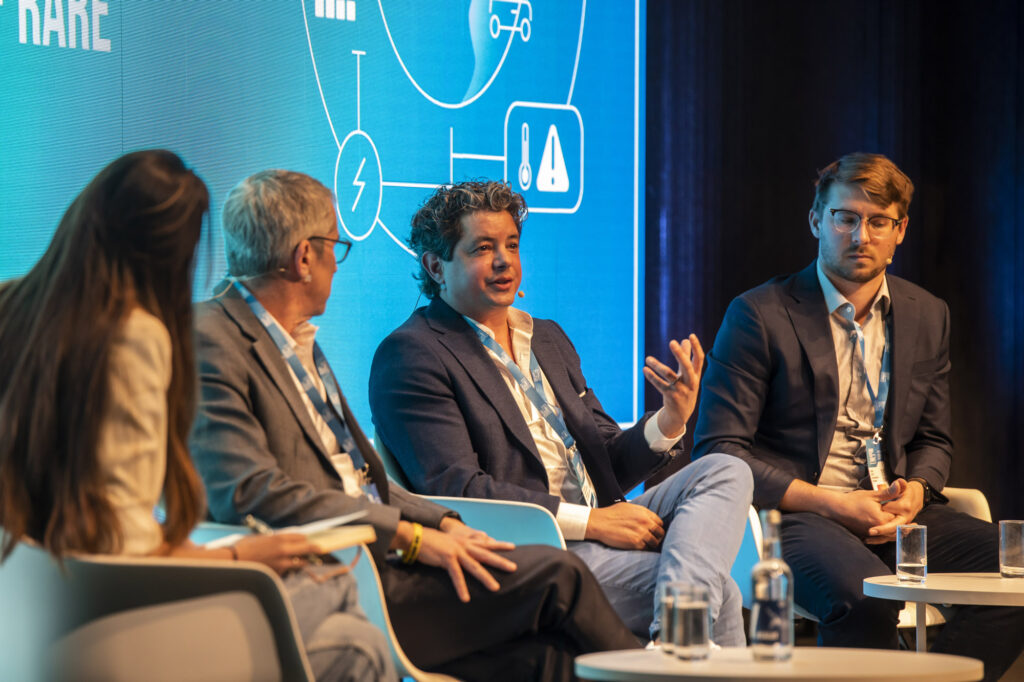
Panelists: Henk Both from Anzu Partners, Rutger Van Raalten from CarbonX, Michael Granoff from Maniv Mobility, and Beau-Anne Chilla from Anthemis uncover the global impact of these essential materials and discuss strategies to navigate the shifting landscape.
China’s grip on rare earth processing
Both explained that rare earths are actually spread fairly evenly across the planet. The real question is where they are mined and processed. There, “the gorilla in the room is China,” he said – “not to make China a boogeyman here.”
The roots go back to the 1980s, when Deng Xiaoping reportedly said that “the Middle East has oil and China will have rare earths.” China invested in mining and processing when other countries were unwilling to accept the environmental damage.
Today, China mines around 60% of the world’s rare earths, according to Both, but controls around 90% of extraction, processing and alloying. It has also made it illegal to export those technologies. Meanwhile, bringing a new mine online can take 10 to 20 years.
Supply as a geopolitical lever
Both pointed to a dispute with Japan around 2010, when China restricted rare earth supply and magnet prices soared. That episode pushed the US to search for alternatives, yet in his view little has changed since.
He also noted China’s later restrictions on graphite exports. In his view, the topic still lacks public attention. “It’s a much bigger problem than people realize,” he said.
Granoff agreed. For him, the defining moment came in 2009, during the financial crisis and the GM bankruptcy. The US had an opportunity to stop the new electrified economy from concentrating in China, but it didn’t act. Now, the imperative is to build new industries.
Looking to the Pacific seabed
Granoff then shared a surprising piece of show-and-tell: a polymetallic nodule from the waters of the Cook Islands. The Pacific nation has around 15,000 people, a land area roughly the size of Washington, DC, and territorial waters about the size of Alaska. Its waters hold trillions of these nodules.
He drew a parallel with oil. When the first Ford Model T rolled off the line in 1908, people thought most of the world’s oil was in Pennsylvania. Once demand exploded, oil was found almost everywhere. In the same way, “stone age did not end for lack of stones.” The minerals exist; the economic incentive will find them.
According to Granoff, processing nodules is no different from processing ore from a land-based mine. However, he urged the audience to judge any reports on seabed mining by their scientific rigor. In his view, deep-sea minerals could be a major opportunity over the next five to ten years if policy supports supply chain diversification.
Three pillars for a competitive supply chain
Van Raalten sees three pillars for Europe and the US. First, ESG performance. Second, traceability, for example through the EU battery passport. Third, localized supply chains.
ESG and traceability can eventually set Western supply chains apart, but only if they are rewarded with incentives. In the meantime, the market cares about cost. Many startups, he noted, focus on sustainability but struggle to deliver at the right supply volume and price. They also need funding to go straight to meaningful scale.
Investing in the rare earth gap
Both put numbers on the challenge. According to Both, the rare earth magnet market alone was worth around $45 billion at the time and was expected to triple or quadruple within a decade. Based on current resources, he believes the supply deficit ten years out could exceed the size of today’s entire market.
As an investor, he looks for differentiated technologies in extraction, refining, alloying and recycling. Much of his time goes to Niron Magnetics, which grew out of US Department of Energy research funded after the 2010 dispute. A University of Minnesota team developed strong permanent magnets made from iron and nitrogen, with no rare earths at all.
Niron’s investors include major automotive and electronics players such as Stellantis, Volvo, GM and Samsung. Yet, in Both’s view, the market is so large that no single company can meet demand. He was struck that so few startups tackle rare-earth-free magnets, compared with the many working on battery cathodes.
From tires to batteries
For Van Raalten, the supply chain crisis changed CarbonX’s direction. He has worked on the material for more than 15 years, first developing it for more sustainable tires.
The tire industry wasn’t ready to change. However, the material could match graphite’s performance in batteries. Europe has few graphite deposits, and synthetic graphite needs vast amounts of energy and scarce feedstock. As a result, CarbonX pivoted to become a localized graphite supply chain solution.
Granoff added that Maniv’s investors include automotive and infrastructure corporations. Part of the fund’s role is to help them build supply chains that don’t depend on materials that may become out of reach or too expensive.
Where the bottleneck really sits
An audience member asked which stage of the value chain is the worst bottleneck. Both explained that mining is only the first of four steps, followed by extraction, refining and alloying. China handles more than 90% of each of the last three. “The odds that you ever touch a magnet that didn’t touch China is essentially zero,” he said.
Those processing steps rely on specialized know-how that can’t be invented overnight. Therefore, all four steps need to be tackled in parallel, but the midstream is the most critical.
Will investors catch on?
Another question asked when venture capital would embrace the space. Granoff warned that hype cycles can push startups to raise money at valuations their technology can’t justify. Still, the problem is so large that, in his view, any hype could prove more sustainable than in other sectors.
Both doesn’t yet see the scale of the opportunity reflected in deal flow. For that reason, he believes now is the time to invest, and expects interest to rise within a year or two.
Van Raalten raised a structural issue. For critical raw materials, “the ticket is going to be large,” so fund sizes need to grow – especially in Europe, where large funds are scarcer than in the US.
Takeaway
The panel agreed that the West faces a serious dependency on rare earth metals and other critical materials. Yet every crisis also brings opportunity.
As Van Raalten put it, “we cannot just copy what happens in China.” Instead, the panel saw innovation as the way forward: new chemistries, new sources and new processing technologies that can compete on both cost and scale.
Secure your pass
Dates for the next Energy Tech Summit Asia are coming soon. In the meantime, join investors and founders tackling critical materials at Energy Tech Summit Europe 2027, the 8th edition, on 7–8 April in Bilbao, Spain.
Passes cost €1,399 until 30 November, then €1,599 from 1 December, €1,799 from 1 February 2027 and €1,999 from 1 March 2027.
Founders can join with the Founder’s Pass for €699. Use code ETS100 for €100 off.