
Founders in the Green Molecules track pitched new ways to make hydrogen, methanol, SAF and green chemicals cheaper, cleaner and easier to scale.
Across Asia-Pacific, shipping, aviation and heavy industry are searching for cleaner molecules. Singapore is the world’s largest bunkering hub, Japan and South Korea are building hydrogen supply chains, and chemical producers across the region face growing pressure to decarbonize.
At Energy Tech Summit, startups in the Green Molecules track pitched technologies that could reshape hydrogen, sustainable aviation fuel (SAF) and green chemicals. Each founder had three minutes to pitch and two minutes to answer questions from an expert jury.
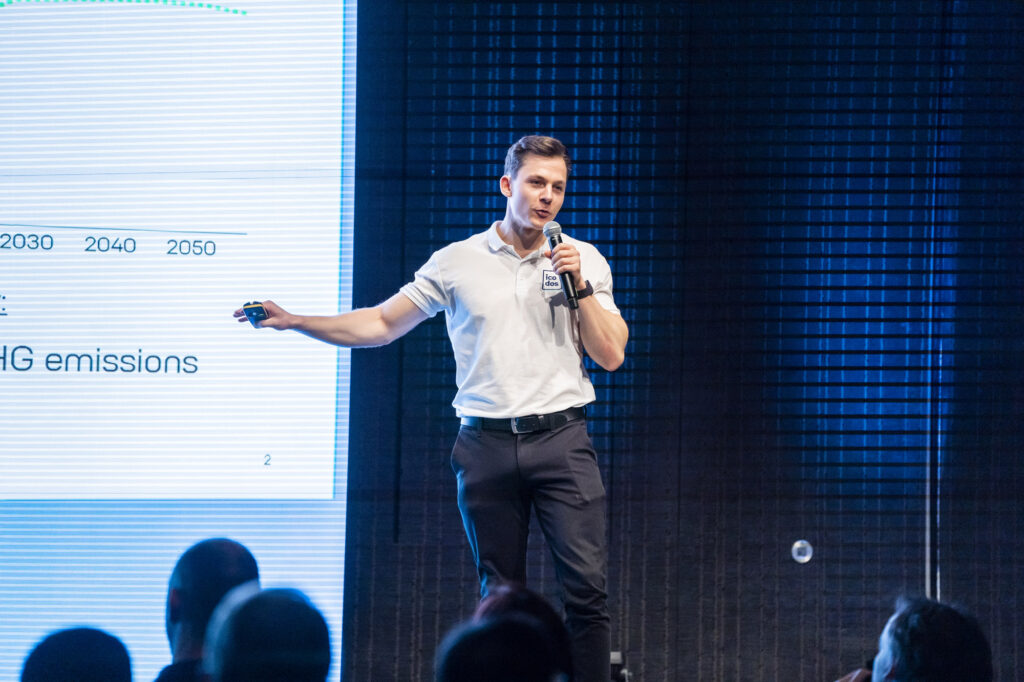
David Strittmatter from ICODOS showcasing their team work on ETS2024 stage.
1s1 Energy: rethinking the PEM electrolyzer
Thiago Figueiredo, Co-Founder of 1s1 Energy, opened by naming the problem: electrolyzers are expensive, use too much electricity and lack durability. In his view, “everybody’s kind of tackling the symptoms” of PEM electrolysis rather than its root causes.
1s1 Energy targets one of those causes: the proton exchange groups. The company has patented new boron-based groups, allowing it to rethink the entire electrochemical cell. As a result, it is developing a vertically integrated electrolyzer that uses less electricity at high throughput, which means smaller systems.
A second generation will run at higher temperatures to cut electricity use further. Some of its components also apply to fuel cells, opening licensing opportunities. At the time of the session, 1s1 Energy was preparing a pilot with a steel and utility company to scale from 6kW to 100kW.
Asked about competition, Figueiredo said PEM has the best fundamentals, since it pairs well with renewables and runs at high throughput. Improving both efficiency and durability is where 1s1 sees its edge. “We’re just scratching the surface,” he added.
ETB Global: bio-based butadiene for greener tires
Gabrielius Sitas, Business Developer at ETB Global, introduced butadiene, a building block for rubber and plastics used in everything from tires to latex gloves. Conventional butadiene comes from fossil feedstock and, according to Sitas, emits more than 30 million tons of CO2 a year.
ETB Global converts bio-based ethanol into butadiene in a single catalytic step. The result is a drop-in molecule that fits existing value chains while cutting CO2 emissions by 60%, Sitas said.
Demand is clear. Tire makers aim to produce green tires by 2030, and they need bio-based butadiene to get there. At the time, ETB Global had a pilot plant running and was preparing to build a demonstration plant, supported by an EU grant.
The jury asked how much of the CO2 saving comes from green ethanol. Sitas explained that most comes from the feedstock, while the one-step process also lowers energy use. The company can use existing purification processes, which keeps capex down, and is working with strategic partners to qualify its product.
HySiLabs: moving hydrogen like any other liquid
Belén Moreno Fresneda, Account Executive at HSL Technologies (HySiLabs), tackled hydrogen’s logistics problem. Today, it needs high pressure or very low temperatures, and dedicated infrastructure barely exists. For HySiLabs, the “energy transition would not exist without the social transition.”
The company charges hydrogen into a silicon-based, carbon-free carrier called HydroSil. The resulting liquid behaves much like a hydrocarbon, so it can use existing fuel infrastructure. To release the hydrogen, users simply add water.
That could connect regions with cheap hydrogen production to places that need energy. Asked about energy use, Moreno explained that energy is spent where hydrogen is produced. The release reaction is exothermic, so heat can be recovered at the destination. HySiLabs adds a fee for transport, which in her view would cost about the same as moving diesel or gasoline today.
HydRegen: tricking chemists into using enzymes
Holly Reeve, CEO of HydRegen, began by interviewing 100 chemical companies. Many of their problems traced back to precious metal catalysts, which bring regulatory, financial and efficiency challenges.
HydRegen’s answer is unusual. “We are looking to trick chemists into using enzymes,” Reeve said. In other words, “we package enzymes to make them look like metal and carbon catalysts,” so manufacturers can use existing infrastructure.
Paracetamol shows the potential. During COVID, Europe came close to running out, and there is political pressure to bring production back. Today’s methods rely on precious metals at high temperature and pressure. HydRegen offers a biological alternative for the key hydrogenation step, running at lower temperature and pressure for a safer, cleaner and cheaper process.
Hydrogenation accounts for around 14% of all chemical steps, Reeve said, from pharmaceuticals to bulk chemicals. HydRegen sells products, runs joint development projects and licenses processes to manufacturers, while outsourcing enzyme production to keep capex low.
ICODOS: flexible methanol for shipping and chemicals
David Strittmatter, Co-Founder and CEO of ICODOS, pointed to the scale of the challenge: shipping and chemicals together account for around 10% of global greenhouse gas emissions, according to Strittmatter. Sustainable methanol is widely seen as a solution, yet it costs at least three times more than conventional methanol.
ICODOS has patented a methanol production process that, it says, can make sustainable methanol at the cost of conventional methanol. It is highly flexible, working with point-source off-gases from biogas, biomass, fermentation, pulp and paper, cement and steel. “I would love explaining this in more detail but this has to wait for the Q&A,” he joked.
The thermocatalytic process runs in one multi-stage reactor, with BASF as a technology partner. At the time of the session, ICODOS had built a demonstration plant in France with EDF and was working towards its first commercial-scale plant with industrial partners. As a technology provider, it relies on customers such as oil, gas and energy companies to secure feedstock.
Jolt: activated electrodes without binders
Leon Rizzi, CEO of Jolt, makes the coatings that turn electrodes into activated electrodes. They serve established electrolysis markets, such as chlorine production and water purification, as well as emerging ones like redox flow batteries, e-fuels and hydrogen.
His advice to investors was direct: “don’t look at the electrolyzers.” Instead, look at the electrode suppliers, where demand keeps growing. In his view, “if you make the electrodes there is no issue.”
Jolt focuses on alkaline and AEM electrolysis. Its one-step process fuses the catalyst into the surface of the substrate in about a millisecond, with no binders. Consequently, there is no flaking or cracking, the main causes of degradation. Rizzi claims Jolt can warrant electrodes for ten years with minimal degradation, using less precious metal. At the time, Jolt said it had moved from TRL 3 to TRL 9 in two years and opened its first large-scale plant.
OCOchem: turning captured CO2 into green chemicals
Todd Brix, Co-Founder and CEO of OCOchem, asked a simple question: “what do we do with all the CO2 that we’re going to be capturing?” Burying it costs money. OCOchem instead adds value to it.
Its CO2 electrolyzer combines water, CO2 and electricity in a single step to produce hydrogen formate. That liquid can be transported conventionally and used to generate hydrogen or carbon monoxide on demand, or to make other green chemicals.
Compared with the incumbent fossil-based process, OCOchem’s route is carbon negative, Brix said. Formate is also among the cheapest molecules to make from CO2. The company partners with industrial CO2 emitters and sells the product to customers who want clean hydrogen, carbon monoxide or chemicals. At the time, OCOchem reported three customer contracts and 18 patents.
The jury asked about CO2 purity. OCOchem prefers high-purity CO2, such as from bioethanol plants, but is also partnering with direct air capture and flue gas capture companies.
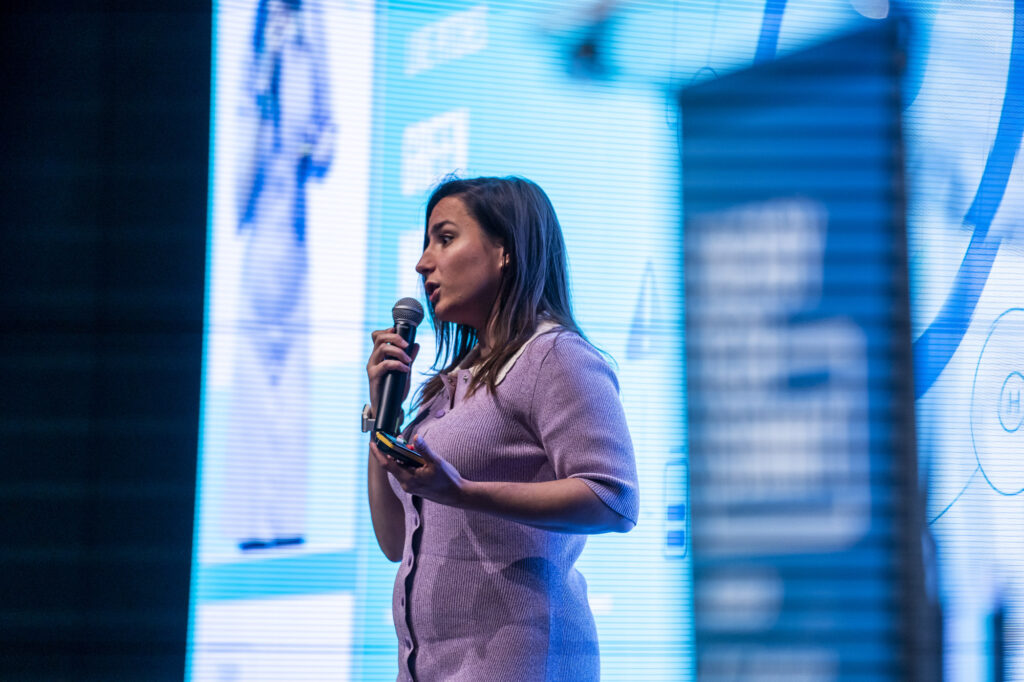
Pitcher Belén Moreno Fresneda from HSL Technologies (HySiLabs) at Energy Tech Challengers 2024.
Spark e-Fuels: load-flexible e-SAF
Mathias Bösl, CEO and Co-Founder of Spark e-Fuels, focused on aviation. It is hard to abate because, as he put it, “there’s no alternative to combustion.” SAF works as a drop-in fuel, but it remains far too expensive.
Spark’s process uses captured CO2 and green hydrogen. A reverse water-gas shift step turns them into syngas, and a Fischer-Tropsch step converts that into fuel. Both are known processes, but Spark makes them load-flexible, so they can follow fluctuating renewable power and cut costs.
Asked how Spark differs from rivals, Bösl said its reverse water-gas shift process converts more than 90% of CO2 and runs at lower temperatures. On cost, he was candid: e-fuels “will never reach fossil,” but he expects Spark’s fuel to land at around 1.5 to two times fossil prices – roughly on par once emission costs are included.
Takeaway
The Green Molecules track showed how many routes lead to cleaner fuels and chemicals. Some startups improve the core hardware of electrolysis. Others reinvent how hydrogen moves, or turn CO2 and biomass into valuable products.
For Asia-Pacific, with its major shipping hubs, chemical industries and hydrogen ambitions, these technologies point to practical ways to decarbonize sectors that electricity alone can’t reach.
Secure your pass
Dates for the next Energy Tech Summit Asia are coming soon. In the meantime, meet the next generation of climate tech startups at Energy Tech Summit Europe 2027, the 8th edition, on 7–8 April in Bilbao, Spain.
Passes cost €1,399 until 30 November, then €1,599 from 1 December, €1,799 from 1 February 2027 and €1,999 from 1 March 2027.
Founders can join with the Founder’s Pass for €699. Use code ETS100 for €100 off.