That mismatch is the whole problem.
Few regions live this question as sharply as Asia-Pacific. Japan imports the overwhelming majority of its primary energy, and several Southeast Asian markets are moving from net exporter to net importer. Meanwhile, the shipping lanes that carry those molecules run through some of the world’s most contested water. So energy security here is not a policy abstraction. It is a map.
Who controls the future of energy?
Rajan Shah, Principal at Morgan Stanley 1GT, opened a panel at Energy Tech Summit 2026 with a deliberately broad question. Who controls the future of energy?
His framing was economic. In a globalized world and a relatively efficient market, scarcity rents accrue to whoever controls the constraints. Today those constraints are typically hydrocarbon supply or shipping. In future, they may be something else entirely.
Who was on stage
Takeshi Kodama is Head of JERA Ventures and Managing Partner at JERA, the Japanese power generation company.
Jan Lozek is Founder and Managing Director at Future Energy Ventures, investing largely in software.
Martin Schichtel is CEO and Co-Founder of Kraftblock, which builds thermal storage systems for industrial heat.
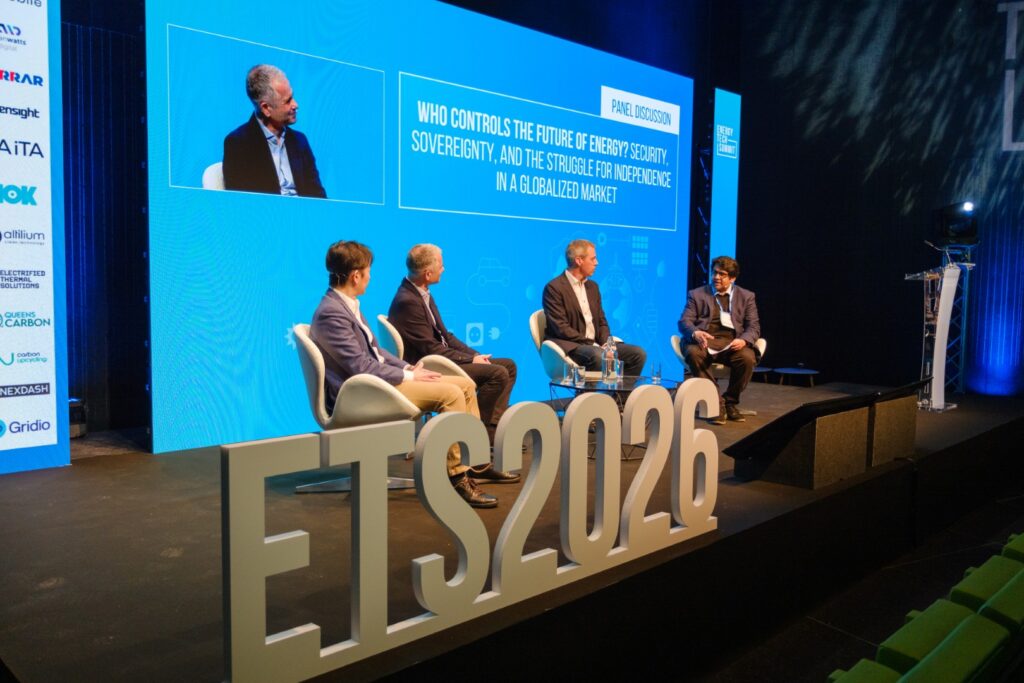
Panel speakers of the main stage session at Energy Tech Summit 2026
Partnership as a de-risking strategy
Kodama’s answer to what control means was that it involves almost everything. He emphasized one mechanism above the rest, though: business partnerships that create a diversified portfolio.
He gave examples from his own company. JERA partners with BP to develop offshore wind in European markets. Simultaneously, it operates a joint venture with EDF to de-risk its trading and handling of liquefied natural gas, which he described as the largest of its kind by volume.
Partnership, in his framing, is not the best solution to the uncertainty facing the energy industry. It is, however, a good one. Shah noted the strategic logic, given Japan’s high reliance on fossil fuel imports.
Access to energy as prosperity
Lozek answered first as a person rather than an investor. Access to energy, in his view, means prosperity. If a country can control its energy, it can master its own destiny.
That matters acutely for Europe, which he said currently sources 57% of the energy it uses from a handful of countries holding power over it. That dependency is now far more visible than in the past.
Looking ahead, he raised a question that will define the renewable era. A renewable system is fully distributed and decentralized, so how do you orchestrate it? How do you build an intelligence layer capable of running an entire energy system for a country, a continent or the world?
Software, AI and digital tools, he argued, are what will let us control that system and take back control of our own destiny.
Have we simply swapped dependencies?
Shah put the cynical case directly. European policy has spent five years reducing dependence on Russian gas, and arguably swapped it for dependence on more expensive American LNG. How, he asked, has that helped energy security?
Schichtel’s answer reframed the problem rather than defending the policy. We will never eliminate these dependencies, he said, because of a structural mismatch. Energy flows globally, while energy systems are designed nationally.
Therefore the goal cannot be removing dependency. It has to be reducing exposure to it.
Crucially, he argued that control sits on the demand side rather than the supply side. What matters is when energy is used, and how. That requires flexibility, which is precisely what the system has lacked. Europe secured gas supply, and gas is there. Yet industries have no ability to react when conditions change.
“Control is flexibility,” as he put it. He meant the ability to operate your system independently in the short term, not the long run. Consequently, he wants the conversation to shift from dependency toward what he called resilient interdependency, with more control at the local level.
Shah adopted the phrase and reinforced it with an example. Even the United States, the famous case of a net importer turning net exporter, lacks the refining capacity for the barrels it produces. So it remains interdependent with global supply chains. True independence is essentially impossible.
What companies are actually asking for
Asked how his customers think about dependency, Schichtel described a mindset that fluctuates with the market. Two price shocks in five years brought everyone back to renewables. Renewables alone, however, are not enough. You also need flexibility, which means storage.
What he sees increasingly is demand for what he called controlled independency. In practice, that means combining fossil and renewable streams on the same site.
The reasoning is financial as much as environmental. Nobody can estimate a gas price five or ten years out. Local renewable generation, by contrast, offers something closer to stabilized pricing, which reduces risk on the customer’s balance sheet.
The resulting systems are hybrid. Storage combined with gas-fired equipment lets a site use electricity when it is cheaper than gas, then switch to the gas boiler when power prices spike. Equally, it can cut gas consumption and shift toward renewables when conditions favour that. Flexibility, in other words, is the product.
Does resilience mean overbuilding?
Shah pressed the obvious objection. Building renewables alongside conventional generation means overbuilding capacity, producing twice the energy you need. Is capital therefore the constraint?
Schichtel accepted the premise and argued the alternative is worse. If you want to reduce future energy security risk, there is no way around investing, because the system as it stands is failing. That future is more electrified, so investment follows electrification.
Grid constraints are real, he acknowledged, and flexibility answers them too. Storage lets a site absorb excess generation when demand is low, then use it days later.
The other option is reducing curtailment. He pointed to Germany paying around 3.5 billion for curtailment last year. Why not use energy that already exists, he asked, either at times when the grid is not overloaded or locally where it is generated? That requires rethinking control of the whole system and moving it toward the demand end.
The investor’s view, and Japan’s baseline
Lozek saw it more simply from an investor’s seat. Renewable assets are profitable and secure energy at lower prices, so investors have every incentive to fund them. Whether gas plants exist alongside them is beside the point. You invest in the next thing that makes economic sense.
Across the entire hardware stack of renewables, heating and generation, he argued, costs now sit below fossil fuel systems. The remaining question is only how to back up periods without renewable generation.
His continental argument was bolder. If Europe invested heavily in electrifying transport, in heating for industry and consumers, and in renewable assets and the grid, he estimated it could save 70% of its imported fossil fuels.That said, the organizing question is harder. How do you actually make that happen, and how do you build the partnerships for it? For him, the economics are settled. What remains is acceleration and unblocking bottlenecks.
Kodama answered the investment question from JERA’s position, which starts from a different baseline. In Japan, more than 90% of electricity has been generated from fossil sources, while renewable output fluctuates. Balancing the two is therefore the priority. The company has begun constructing long-duration battery storage adjacent to existing domestic generation, to stabilize supply to the grid.
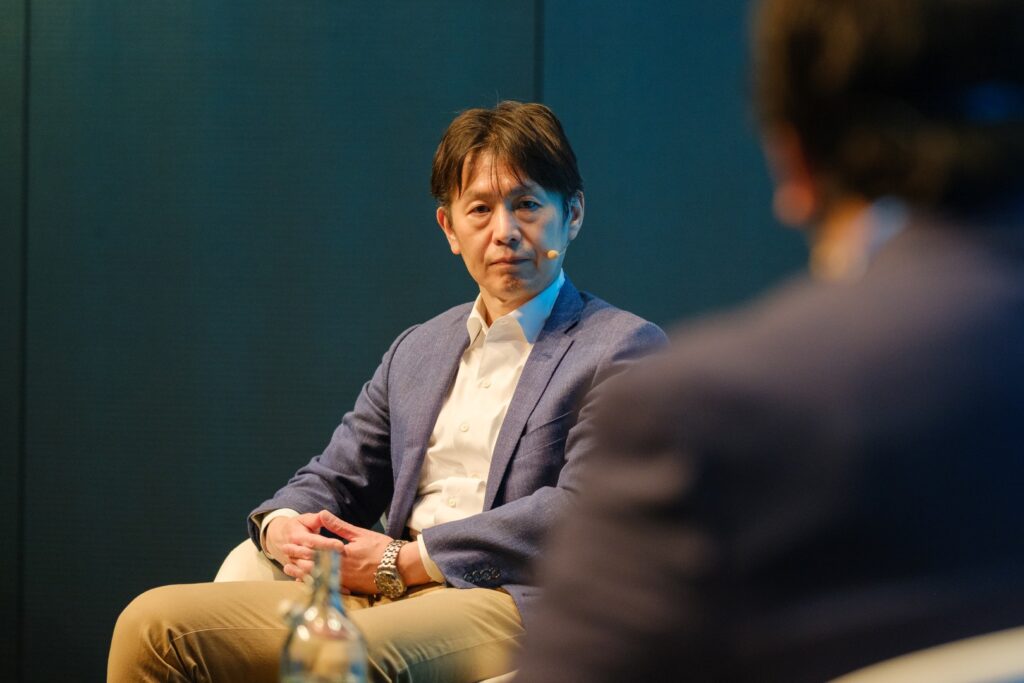
Takeshi Kodama, Head of JERA Ventures and Managing Partner at JERA during Energy Tech Summit 2026 panel
Supply chains, and a contract that expired
Shah moved to supply chains. Resilient interdependence, he noted, depends entirely on obtaining the materials needed to build the infrastructure that delivers independence.
Kodama answered with a case from his own experience. Together with the Japanese government, the company signed a long-term contract with a Qatari supplier to export liquefied natural gas to Japan and other countries. Then conflict intervened, force majeure was triggered, and the contract expired.
The lesson he drew is that a broad portfolio of upstream LNG positions is essential to energy security. None of it is achievable, though, without communication between governments and business partners. Partnership, again, was his answer.
Shah admitted it had been a trick question, since extricating yourself from global supply chains is close to impossible. He then asked about the alternative approach: localizing supply chains entirely.
Onshoring, and what it would take
Lozek argued for doing both, and separated the question into two parts.
The first is sourcing fossil fuels, where Germany switched from Russia to Qatar and the US. That is solved, in his view, though he considers it a quick fix rather than a strategy. The long-term answer is building out the renewable system.
The second is materials for building that system, including batteries. Here he sees a considerably smaller problem, because you invest in those materials once and then use them for decades. It still has to be secured. Even so, it is a different kind of exposure.
Fundamentally, he argued, you need all of it. Keep working and collaborating across Asia, Europe and America, and keep channels open at every level. Business people are used to working together and should continue doing so.
Even so, recent experience in other domains has shown Europe how exposed dependency can leave it. Therefore he wants a baseline of domestic resources and tools. That means onshoring some core manufacturing functions, using technology to make it efficient enough to compete, in order to hold leverage when situations demand it.
Who pays for it
Shah laid out the industrial policy options and their costs. Subsidizing local manufacturing burdens taxpayers. Stockpiling materials and minerals is likewise expensive.
Lozek’s response reframed the affordability question entirely. Europe currently spends 3% of its GDP on fossil fuels. Stop paying that, he argued, and sufficient capital exists for everything the panel had discussed.
So it becomes a question of focus and political alignment. Yes, the transition is costly. In his view, though, it is considerably less costly than continuing the present course.
Where energy security meets cyber security
For the final topic, Shah connected energy security to cyber security, noting that energy assets face attack attempts on an enormous scale each year.
Kodama expects false flag attacks on utilities and energy companies within a few years, because the pace of AI capability is running well beyond expectations. His key distinction was between IT and OT. Cyber security for the energy industry matters most on the operational technology side.
Lozek agreed emphatically. In a distributed, decentralized system managed through a central platform, the number of attack surfaces multiplies. That makes cyber security part of the core technology stack of any future energy system.
He spoke from experience. While working at a large utility, the business came under attack, with millions of customers at risk at one point. Combined with the geopolitical strategies of certain nations seeking leverage, that makes it a substantial risk for utilities and for countries.
Audience at Energy Tech Summit
Takeaway
Shah’s closing synthesis was that independence is a pipe dream, and resilient interdependence is the realistic destination. That requires coordination between capital markets, policymakers and companies. Every bottleneck is individually solvable, and every solution costs money. What makes the panel worth reading is Schichtel’s reframing underneath it. If dependency cannot be eliminated, then energy security stops being a question about where your molecules come from. Instead, it becomes a question about whether you can switch when the terms change. On that definition, flexibility is not a feature of the energy system. It is the security.
Energy Tech Summit Asia comes to Kuala Lumpur on September 29–30, where that question sits at the centre of the programme.