
Cooling that reaches minus 35°C, solar stored as heat for days, a fusion reactor shaped like a pipe, and a flywheel made of recycled steel. Inside the Scaling Computing pitches at Energy Tech Summit.
Data center energy has become the transition’s fastest-moving constraint. Compute demand is not waiting for the grid to catch up, so the finalists in this track attacked the problem from every layer at once: the chip, the cooling system, the building, the interconnection queue and the generation behind it. What follows is what each of them pitched, and what the jury pushed back on.
Coolgradient: optimization without new hardware
Jasper de Vries opened on institutional friction. A single energy optimization can require a lengthy technical document and weeks of implementation, when the change itself amounts to pressing a button. Meanwhile a quarter of the industry’s most experienced people approach retirement, and facilities designed to last decades now serve server requirements that change every year.
Coolgradient sells no hardware. Instead it uses the sensor data operators already collect – valve openings, floor pressures, temperatures, fan speeds – and applies machine learning to generate specific recommendations with predicted impact. Teams need about an hour of training. “No guesswork, no data science degree.”
The sequencing matters more than the models. Around 60% of the platform’s optimizations first uncover hidden maintenance faults, so the system fixes malfunctions before tuning set points, which avoids optimising a broken configuration.
Revenue is subscription, priced on power capacity. The focus is colocation, for two reasons: savings land directly in the operator’s pocket, and colocation groups run multiple facilities, which suits a land-and-expand motion.
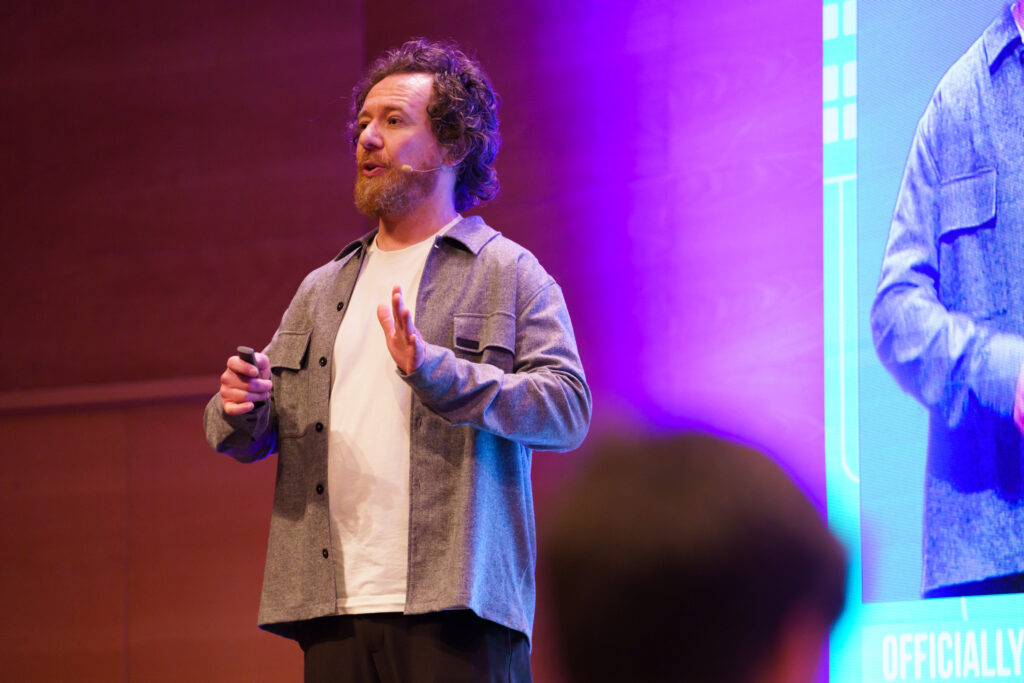
Jasper de Vries, Co-Founder and CEO of Coolgradient showcasing the company at ETC2025.
Exowatt: solar stored as heat
Hannan Happi started from a number rather than a technology: “we wanted to be able to generate electricity at 1 cent per kilowatt hour”. Everything else followed backwards from there, through dozens of configurations.
The product collects sunlight as heat through an optical system, stores it in a long-duration heat battery for several days, then dispatches electricity through a built-in modular heat engine. Because it ships from a factory, it needs no on-site construction and no long lead times – which addresses what data centers actually care about, time to power.
The jury raised the obvious objection: solar thermal has failed at this before. Happi’s answer was modularity. Older systems chased efficiency through size, then lost the economics to construction delays and cost overruns. Building small units in volume instead follows the cost curve that PV and batteries already travelled. And storing heat beats storing electricity, with no degradation and no fire risk.
The unit produces three-phase AC, so it works behind the meter, on-grid, or paired with PV and wind to approximate baseload.
Incooling: air conditioning for the chip
Rudie Nolasco Verweij framed today’s approach as a category error. Cooling consumes up to 40% of data center electricity because the industry treats the whole building like a fridge, when the heat actually comes from small chips buried inside servers.
Incooling, built on technology originating at CERN, puts refrigeration inside the server itself. For the facility, nothing changes: “cold air in, hot air out. Business as usual.” That removes the modification barrier that slows every competing approach.
The performance claims are aggressive. Cooling the chip harder raises application performance by up to 50% and cuts energy per task by 40%. It also travels – no specialised air conditioning means compute can go where compute normally cannot, including defence applications outside a data center.
The target is legacy air-cooled sites that want next-generation hardware but lack the cooling headroom for it. On direct-to-chip competitors, Nolasco Verweij was unambiguous: the system runs down to minus 35°C, and “we build the fastest servers in the world, period”. It costs more, and he said so.
Go-to-market has flipped. After selling directly and clearing vendor qualification, the company is now moving to sell through OEMs – the route it originally wanted, and was refused.
Piq Energy: getting through the interconnection queue
Dionysios Stamatiadis identified the bottleneck as paperwork rather than physics. Cheap, fast grid access is gone, and developers on both sides – renewables and data centers – struggle with the cost and speed of connecting.
The people doing that work have deep expertise but legacy tools, manual processes and spreadsheets. Consultants, meanwhile, have no commercial incentive to automate themselves out of billable hours.
“The race is on,” and Piq Energy sells the edge. The platform combines clean, continuously updated datasets with automated power system studies, so a developer walks into a utility meeting already knowing the constraints, understanding how competing projects affect their own, and carrying alternatives such as flexibility or curtailment-aware designs.
The commercial model is deliberately staged. Piq starts by replacing traditional engineering resources, works alongside the customer for a few months until the use case is fully understood, then converts them to a subscription where they self-serve the same questions.
Asked about the underlying utility data, Stamatiadis was candid: access is not the hard part. Making decades-old data useful is, which is why the team hired data scientists rather than just power engineers.
PROUD: a diamond layer at the source
Wai Kwan Isaac Chan, from the EPFL spin-off, picked up Incooling’s argument and moved it one layer deeper. Heat is not only an energy cost. It also constrains how advanced semiconductor packaging can be built, which makes it a manufacturing problem as much as a facilities problem.
Conventional materials – copper, aluminium, silicon, silicon carbide – cannot move heat away from the source fast enough. PROUD deposits an extremely thin diamond layer instead, measured in hundreds of nanometres, which dissipates heat directly where it is generated.
That thinness is also the cost answer. The company is not supplying bulk diamond, so material cost stays low, though Chan acknowledged that fitting into the semiconductor supply chain remains a long road requiring purpose-built equipment.
The technology complements other cooling rather than replacing it, making downstream systems more effective. Revenue comes from IP licensing, wafer sales and co-development projects.
Realta Fusion: cheap abundant energy, eventually
Kieran Furlong noted that every previous pitch had been about saving energy, then proposed the opposite: getting back to cheap abundant energy. His pitch was for “a pragmatic path to commercially competitive fusion energy”.
The geometry is the argument. Rather than a tokamak or stellarator, Realta uses a cylinder – a plasma pipe – with high-temperature superconducting magnets clamping each end to hold hydrogen isotopes in place. Neutrons carry energy into a fluid blanket flowing along the cylinder.
That shape makes it modular. Three standardised components scale linearly across a wide power range, and above that, units stack in parallel.
Go-to-market avoids the grid entirely, targeting behind-the-meter industrial processes and energy self-sufficient data centers in markets where power is expensive.
On why fusion succeeds now, Furlong gave two reasons. High-temperature superconducting materials make sufficiently powerful magnets possible. And private capital has arrived after decades of public underfunding. On competing approaches, he was direct: large toroidal reactors look to him like science projects, whereas a linear device is something a chemical engineer can get his head around – and can wrap a heat exchanger around.
Revterra: inertia against GPU spikes
Patrick Flam explained a failure mode specific to AI. A single GPU running a model swings its power draw by over 90% within milliseconds. Multiply that across thousands of synchronised GPUs and a site sees tens of megawatts appear and disappear almost instantly, which creates transients and voltage and frequency problems.
Revterra’s kinetic stabilizer sits between source and load and absorbs those swings with physical inertia. Because it connects passively at grid frequency rather than through active control, the response is “physically instantaneous” – ahead of any UPS, which needs milliseconds to react. Customers can also run without power electronics, cutting cost and improving reliability.
The device is expected to be built almost entirely from recycled steel and to be recyclable again at end of life.
Asked what operators do today, Flam said they overbuild UPS capacity or throttle computing. Asked what separates this from decades-old flywheels, he pointed to a new bearing design that allows a far larger unit, spinning slowly enough to stay grid-synchronous rather than at the very high speeds traditional flywheels require.
VEIR: superconductors inside and outside the building
Mart Duitemeijer closed the track with a limit that has nothing to do with chips. Data centers are constrained by the power they can access, and “the AI workloads of tomorrow will break our grids as we know it”.
VEIR’s first product is a superconducting transmission line carrying five to ten times the capacity of a conventional conductor in the same footprint, with no losses – which lets grid operators expand within existing corridors instead of acquiring new right of way.
The second product came from a customer question. A hyperscaler asked whether the same technology could shrink power infrastructure inside the building, where cables and busbars max out as rack densities climb. A paid demonstration showed it could, by a factor of more than ten. That cuts construction cost, allows racks to sit closer together for lower latency, and reduces cooling load.
Duitemeijer was refreshingly precise about limits. Superconductors will never be the whole grid; the case is the small share of it where permitting delays run to years. Next to a conventional line the cost looks bad, but per megawatt-mile it competes. And with no voltage drop, power blocks no longer need to sit beside the data hall.

Mart Duitemeijer from VEIR pitching their solution to investor jury at Energy Tech Challengers 2025.
Takeaway: three layers of the data center energy problem
The track split cleanly. One group attacks demand – better cooling at the chip, better tuning of the building. A second attacks the connection – software to get through the queue, superconductors to move more power through the same corridor, inertia to survive what AI does to power quality. The third attacks supply, with dispatchable solar heat now and fusion later. Almost nobody pitched more generation on the same old grid, which tells you where the industry thinks the bottleneck actually sits.
Secure your pass
Energy Tech Summit brings together the startups, investors and corporates building the energy transition. Founder’s Pass is €699, fixed.