
Regulators are simplifying and deadlines are slipping. So what keeps decarbonization moving? Four leaders on incentives over mandates.
Corporate net zero looks different when the mandates are lighter. Across much of Asia-Pacific, disclosure rules are arriving unevenly and on different timetables. Meanwhile, exporters in the region already answer to customers in Europe and elsewhere who carry hard reporting obligations of their own. So the pressure often travels through the supply chain rather than through a regulator. That makes the question on this panel the practical one here. What would a company do anyway, without being told?
Corporate net zero after the reporting wave
Rules are being simplified, filing dates are moving, and companies have to decide what they actually want to keep doing. At Energy Tech Summit 2025, a panel spanning a global bank, an industrial manufacturer, a carbon accounting platform and a development bank worked through that question. Joaquin Munoz, Partner for Corporate Sustainability and Climate Change at ERM, moderated.
Anton Kotov, Head of Corporate Strategy and M&A at ABB, called the impact of the European Green Deal and CSRD “quite massive”, and mixed. “It’s also a double-edged sword,” he said.
On one side, the rules catalyzed action. ABB aligned its targets with a 1.5-degree pathway. It also started working far more closely with peers, suppliers and customers.
On the other side, reporting absorbed the room. Teams spent months working out what to disclose, then how to source the data behind it. Kotov admitted the company almost lost sight of the actual point, which was helping customers solve climate problems.
Angel Gimenez Palazon, Head of Energy & Sustainability at BBVA Spain, recognized the pattern immediately. He welcomed simplification, because it forces a useful question. Does all that gathered information help anyone decarbonize? The omnibus proposal to simplify EU sustainability reporting was still under discussion at the time of the session.
Reporting had a second effect at the bank, though. Teams began designing products for clients who will face similar demands later. Some will meet them through regulation. Others will meet them through their position in someone else’s supply chain.
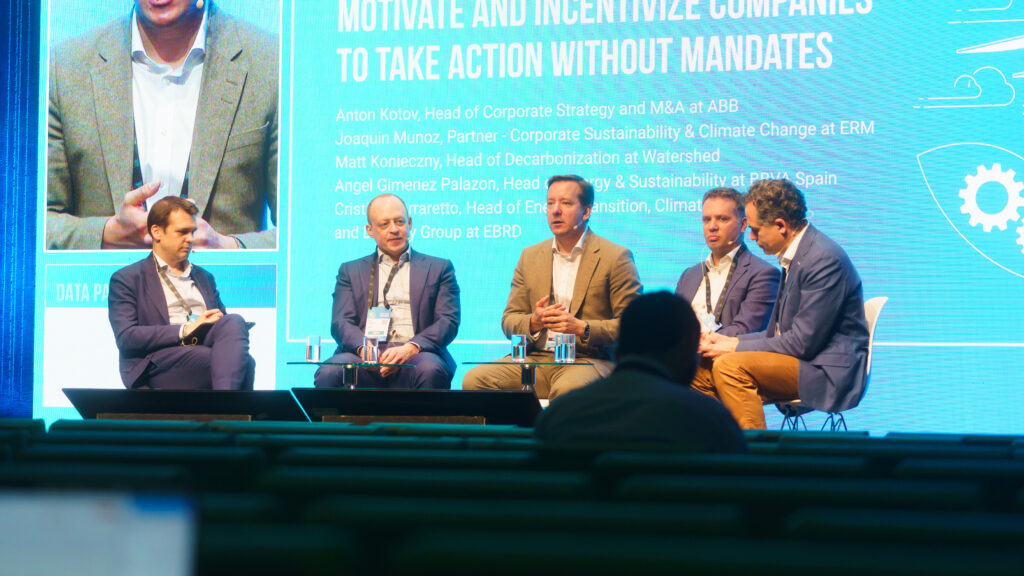
Anton Kotov, Head of Corporate Strategy and M&A at ABB speaking at the panel
Transition plans as a financing tool
Gimenez Palazon set out three reasons a company builds a corporate net zero transition plan. First, regulation requires it. Second, a large customer requires it. Third, and this is the one the bank likes, the company sees a competitive advantage in having one.
That third motive changes the conversation. Rather than pushing high-emitting sectors to transition alone, the bank looks for cases where the numbers already work. That means proven technology, real savings, and a return the client can see.
Cristian Carraretto, Head of Energy Transition, Climate Strategy and Delivery Group at EBRD, works mostly in emerging markets. Clients there often carry heavy transition risk, with brown assets and no credible plan to start from. “So in a way step one is the stick,” he said. To receive financing, a company must commit to develop a credible decarbonization plan within the first years of the relationship.
Then the table turns. Where time allows, the bank helps build the plan first, then shapes the instrument around it. A third party certifies the targets and checks them periodically. Pricing then moves with performance. “So all of a sudden you turn the challenge into an opportunity to scale up your investment basis,” Carraretto said. The plan attracts other investors and opens capital markets. Consequently, the company ends up with far more funding than one lender could provide.
Pushing incentives down the supply chain
The same corporate net zero logic travels downward. Carraretto described deals where EBRD lends to a borrower on climate conditions. It then adds a credit line, concessional finance or grants that the borrower passes on to its own suppliers. Suppliers access that money once they set transition plans of their own.
The mechanism is neat. Typically the grant offsets part of the price discount a supplier had to concede to win the supply agreement. In other words, decarbonization becomes a financial incentive rather than a demand.
At ABB, scope 3 is dominated by a single product family. Around 90% of it comes from motors, where the company is a global leader. Dropping them would shrink the number and help nobody, since efficient motors cut customer emissions. So the focus moved to avoided emissions, circularity, and comparable product carbon footprints agreed with peers. Comparing declarations across manufacturers used to be, in Kotov’s words, “all apple and oranges”.
Matt Konieczny, Head of Decarbonization at Watershed, sees the pull rather than the push. “I’m not seeing people abandon their scope 3 programs,” he said. One customer recently signed a long-term power offtake because it supplies a defense manufacturer. That manufacturer in turn supplies a government running its own scope 3 programme. “So somewhere up your chain, there is a scope 3 program.” Revenue, in short, is at risk.
The business case beats the moral case
Konieczny was blunt about the previous era. Money flowed, expectations were loose, and programs could be almost anything. “Ironically that was unsustainable,” he said.
Today companies want corporate net zero work to deliver value, not charity. They no longer want a program built on planting trees somewhere far away. “I think the path to getting this right is to talk to businesses the way they want to be talked to,” he argued, “and stop talking to them as if they’re just going to do the right thing because they won’t.” The job, therefore, is to save money, make revenue or strengthen the story behind the business.
For a model, he pointed away from the usual technology leaders with wide margins. A large industrial company on tight margins introduced an internal carbon price instead. That single move let every sustainability decision be judged like any other investment decision. It also helped unlock a major green bond and strengthened supplier relationships.
The barriers that still slow corporate net zero down
Kotov named recency bias as the first drag on corporate net zero. Enterprise risk registers chase the latest shock, whether a cyber incident, a trade war or geopolitical instability. Slower risks, meanwhile, wait their turn. Climate rules at least forced a longer view. How many factories and distribution centres sit in flood, wildfire or landslide zones? What would that actually cost? Those events may not have hit yet, and that is precisely the point.
Gimenez Palazon split the financing problem in two. First-of-a-kind projects leave a real gap, so funds, subsidies and banks have to align. Proven and profitable technology needs a different push entirely. Show the client the return.
His example was a hotel on the coast. Once, the pitch was about filling rooms. Now the conversation covers drought restrictions that could empty the pool, or sea level rise that threatens the building itself. Resilience investment is bankable, because banks want clients who are still trading in a decade. New products are appearing too, including parametric insurance tied to temperature or water levels.

Matt Konieczny, Head of Decarbonization at Watershed
Timing, governance and the value of better data
Carraretto raised the hardest constraint, which is timing. Steelmakers decide today on core processes that then run continuously for a decade. So a single investment window shapes emissions well into the 2030s. “It’s not so simple because the technology might not be there yet,” he said, pointing to hydrogen-based direct reduction and the supply questions around it.
Internal governance matters just as much. Can the investment committee approve a payback beyond four or five years?
Konieczny closed on something less glamorous: data. “The carbon footprint is an excellent way of identifying where you have inefficiencies,” he said. One customer discovered it was still paying utility bills for offices it had closed, spotted only because the emissions were still showing up. Companies keep signing up for carbon accounting even as filing deadlines slip, because the data itself has value.
Takeaway
Corporate net zero now depends less on mandates and more on mechanics. Transition plans unlock cheaper capital and bring new investors along. Supply chain requirements travel downward, so revenue depends on them. Physical risk shows up in cash flow models rather than in slide decks. Better data, meanwhile, usually finds waste. The panel agreed on the underlying point. Make the business case, or the work stops as soon as the pressure does.
Energy Tech Summit Asia comes to Kuala Lumpur on September 29–30, where that argument matters most.