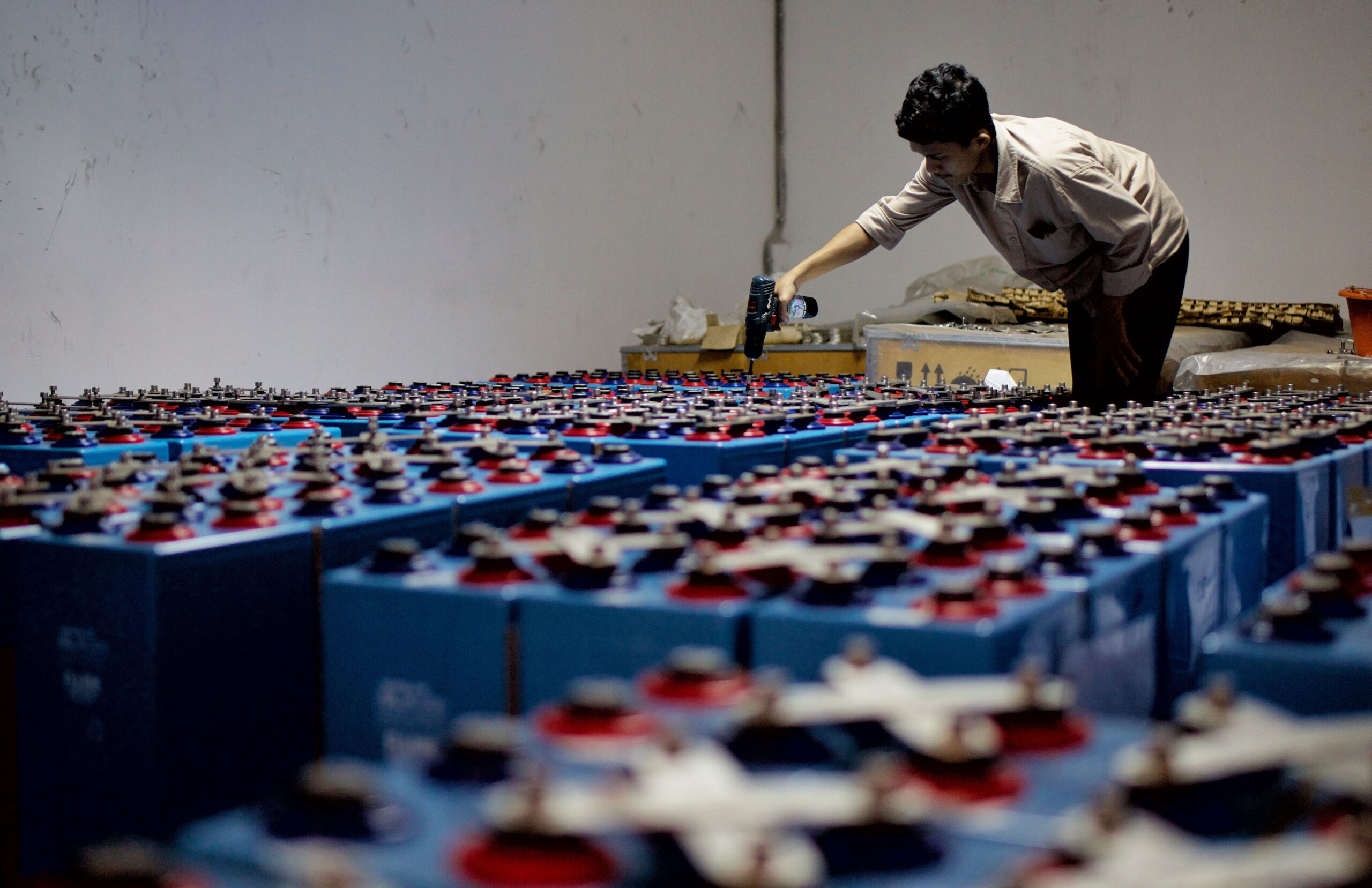
The battery industry spends enormous effort containing thermal runaway. Enerpoly’s argument is that the effort would be better spent elsewhere.
Asia builds most of the world’s batteries, which makes an argument about zinc-ion batteries land differently here. Meanwhile, the region’s storage sites run hot and humid, and much of the new data centre capacity sits in exactly those conditions. Thermal management is therefore not a line item. It’s a design constraint on everything around the cell. So a chemistry that removes fire risk removes something the region pays for repeatedly.
The Innovation Tax Nobody Names
People usually discuss zinc-ion batteries as a supply chain story: abundant materials, no critical mineral dependency, production that can sit anywhere. Eloisa de Castro, CEO and co-founder of Enerpoly, has made that case at Energy Tech Summit before. At Energy Tech Summit 2025, she made a different one, about safety, and specifically about what safety frees up.
Ask anyone about the safety of zinc-ion batteries, or any other chemistry, and the image is the same: a battery fire. Those fires occur across the supply chain. The industry has responded with genuine ingenuity, through better battery management, advanced cooling, fire suppression, and new materials.
De Castro was explicit that she supports all of it. Her question was what it costs to need it. “What can we enable if that’s something that we don’t have to worry about?”
The list of triggers explains the scale of the problem: external heating, physical damage, an adjacent cell catching fire, particle contamination, overcharge, over-discharge. Engineers have to design around each one, and the cumulative response shapes everything from cell spacing to cleanroom requirements.
Her framing is that this is an innovation tax, and zinc-ion batteries are her way of refusing to pay it. Engineering effort spent containing thermal runaway is effort not spent on energy density and cost. Those two variables, in turn, determine whether operators deploy storage at all.
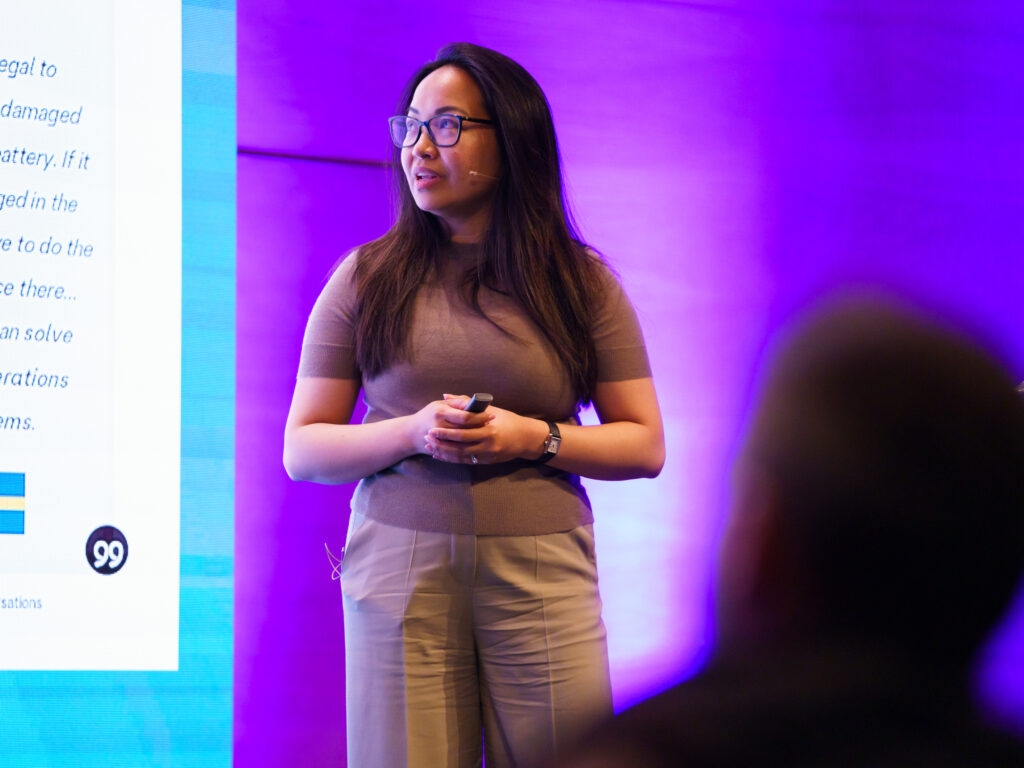
Eloisa de Castro, CEO and co-founder of Enerpoly speaking at Energy Tech Summit 2025
What Enerpoly Builds
Enerpoly develops zinc metal batteries, which de Castro described as a higher volumetric energy density version of zinc-ion. It manufactures both cells and packs in Stockholm.
The active materials are zinc and manganese dioxide. Because both are genuinely abundant, the supply chain argument works anywhere, rather than only in Europe. In addition, the chemistry is non-toxic. People discuss that even less than the fire question, she noted, despite it mattering to plenty of deployment sites.
Where Zinc-Ion Batteries Change the Deployment Maths
The customer benefits of zinc-ion batteries follow directly from the chemistry, rather than from any feature Enerpoly added.
Deployment therefore becomes possible in protected environments, and in places that cannot tolerate toxic leakage. Meanwhile, noise drops too, because the system no longer needs loud thermal control and suppression equipment. De Castro flagged that as valuable to utility and grid storage customers — a group people rarely associate with acoustic constraints.
Maritime applications, for example, need safety margins that shipyards and ports enforce strictly. Data centres, meanwhile, get an operational simplification that’s easy to miss. Shippers cannot transport damaged lithium-ion batteries. Removing that failure mode therefore removes a maintenance headache, rather than just a hazard.
The Numbers, Across Three Parties
The strongest part of the zinc-ion batteries pitch was that savings accrue to different people at different points in the chain. Moreover, each party gains for a different reason.
First, for Enerpoly as a manufacturer, several requirements disappear. No cleanrooms, no dry rooms, and no complex toxic solvent recovery systems to build. That produces a substantial cut in energy consumption, which de Castro put at at least 25%.
For system integrators, fewer components mean savings on space and system cost, which she estimated at 5 to 15%. Transport cost savings run from 10 to 50%, based on external expert estimates.
For end users, the largest single number is insurance, where her estimate was a 67 to 75% reduction. A battery that cannot enter thermal runaway is a fundamentally different risk to underwrite.
Where the Company Stands
Enerpoly is further along than most zinc-ion batteries developers. The Stockholm factory has 100 MWh of annual production capacity, with ramp-up through 2026. De Castro closed with a figure meant to land as a capital efficiency argument. The company reached this point on only €2 million in equity, which she attributed largely to what the safety profile removes from the cost base.
She summarised the pitch in one line: “0% chance of thermal runaway, 100% European supply chains.” The company is seeking both partners and investment.
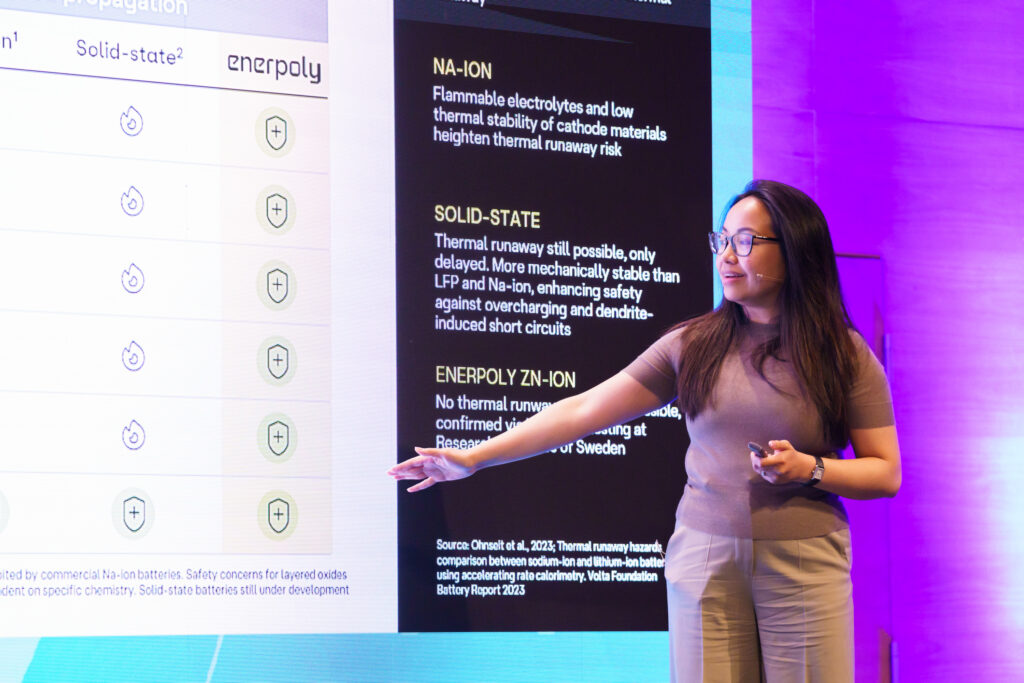
Eloisa de Castro presenting Enerpoly at Energy Tech Summit 2025
Takeaway
The industry usually pitches zinc-ion batteries on inputs, meaning what goes into them and where they come from. De Castro’s argument inverts that to focus on outputs. Specifically, it focuses on the engineering, floor space, transport restrictions, and insurance premiums that exist only because a different chemistry can catch fire. Whether the cost figures hold at scale is the open question, and the ramp-up will answer it. The framing, though, is worth borrowing. People usually treat safety as a constraint to satisfy, not as a budget line that could go somewhere more useful.
Energy Tech Summit Asia comes to Kuala Lumpur on September 29–30, in the region that builds most of the world’s cells.