A single AI chip draws as much power as a household, and millions ship every year. Does that pressure help the transition or break it?
Nowhere is this question more immediate than Asia-Pacific. Malaysia, Singapore and Johor have absorbed a large share of the region’s new hyperscale capacity, and Southeast Asian grids are carrying loads planned for a different decade. Meanwhile, the clean supply those facilities want is unevenly available across the region. So the hyperscalers and clean energy problem arrives here with less slack than almost anywhere else.
A small country’s worth of new demand
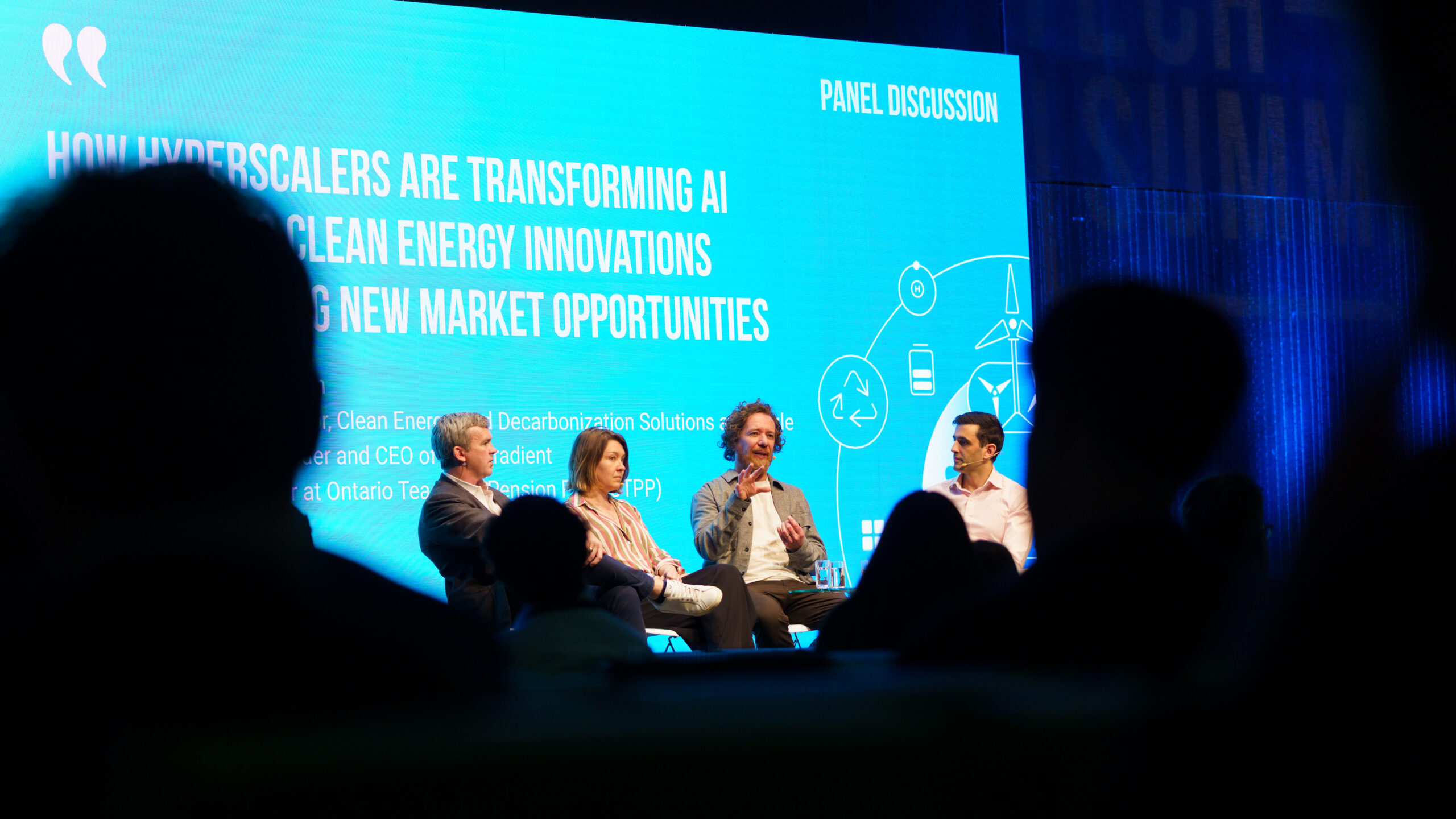
Kieran Mahanty, Director at Ontario Teachers’ Pension Plan, opened the panel at Energy Tech Summit 2025 by putting the scale in domestic terms. A single high-end AI chip consumes roughly what a US household does, or two or three European ones, and millions ship each year. In effect, a small country’s worth of consumption is being added just to run the models people already use.
His framing question was the interesting part. That demand is coming regardless. So is it good or bad for the energy transition? His own hypothesis leaned positive. It puts businesses with enormous revenue and earnings firmly into the energy problem, prioritising it and pushing on clean solutions.

Kieran Mahanty, Director at Ontario Teachers’ Pension Plan speaking at Energy Tech Summit 2025
Growth that is not actually new
Maud Texier, Global Director for Clean Energy and Decarbonization Solutions at Google, pushed back gently on the idea that hyperscalers and clean energy is a new pairing.
Electricity consumption across the wider ICT sector has grown at roughly 20% year on year for a decade. Constant growth is therefore not a new theme. What is new is the step change, which means deploying far more capacity in a much shorter window.
She also put data centres in proportion against everything else electrifying. Projected additional electricity demand by 2030 spans EV charging, industrial electrification and data centres together. Data centres represent only a share of it.
Her outlook was deliberately optimistic. The stress and constraints are real. Even so, she sees them as the opportunity to connect what used to be a clean energy conversation with the physical questions of the grid. That means driving clean capacity onto grids, then moving those grids toward digitalization, optimization and real-time operation.
Utilities dealt the wrong hand
Sean Kelly, CEO of Amperon and previously nearly two decades in energy trading, explained why the system was unprepared for the hyperscalers and clean energy build-out.
Demand was flat for so long that utilities planned around it. Around 2010 the conversation was energy efficiency and LED lighting, with an expectation that the grid would shed demand. They were, as he put it, handed the wrong deck of cards.
He was also clear that hyperscalers and clean energy is not a political question. If the major technology companies decide there will be a lot of data centres, there will be a lot of data centres.
What makes it harder is that these are enormous concentrated loads. They also need to be on good behaviour, flexible enough not to draw full power during the tightest, most expensive hours. Meanwhile, the conventional escape route is closed. You cannot get a natural gas turbine delivered until the end of this decade.
Data as the real constraint
Jasper de Vries, Co-Founder and CEO of Coolgradient, brought 25 years in data and AI across pharmaceuticals, insurance and e-commerce. He also made the panel’s most useful reframing.
Nobody has the answer, because the energy transition is a multi-headed beast requiring knowledge from many domains at once. He described visiting a utility whose main challenge, in their own words, was no longer power lines. It was data, and the communication of data.
His interest is bringing that data together to understand, factually, what is happening across domains. Demand and supply are not aligned. There are many players beyond data centres, and microgrids add another layer. Understanding each other’s needs from a complex systems perspective is where he sees the opening.
Why location got harder for hyperscalers and clean energy
Texier gave the clearest account of how hyperscaler planning has changed. It is a procurement story rather than a technology one.
The old model was essentially first-in-first-out with utilities and transmission operators. Request capacity, receive a timeline and a system upgrade cost, then proceed with the land. That no longer works in concentrated locations, where the capacity simply is not available.
The obvious alternative is to move the workload elsewhere. Several things constrain that, though. Data sovereignty questions govern where data sits and where models train and run. Latency and fibre network limits bite too. So does the multi-year build time for infrastructure itself.
So the response splits by horizon. Looking out to 2028 and beyond, there is time to be proactive through new regions, early engagement with local utilities, and building clean capacity portfolios. The two-to-three-year crunch is harder. In the pinch points, the question stops being about clean energy specifically and becomes about energy and capacity at all.
The load that behaves like a battery
Flexibility was the strongest thread connecting hyperscalers and clean energy, and Texier traced how Google’s motivation for it shifted over time.
The first demand response programme launched in 2020 under the name carbon intelligent compute, shifting workloads across time and somewhat across location based on grid carbon intensity. Carbon was the original driver.
Then the use cases multiplied. The programme expanded significantly when the war in Ukraine brought the first European winter of serious electricity and resilience concerns, with load shifted away from early evening peaks.
Now the two motivations have converged. Flexibility is becoming a requirement, because it allows more compute on existing grids without new power plants or slow, expensive upgrades. The question is no longer only how much you consume. It is when, and how differently you can consume it.
Kelly extended it. Run correctly, a data centre looks like a big battery. A flexible load giving capacity back is functionally the same as turning on generation.
De Vries took it further still, arguing data centres are becoming generators in their own right. They have land, they need power, and they have the capital, which makes the microgrid concept a natural fit. They also already hold storage capacity on site. So storing power when the grid mix is green and releasing it when demand is high is available to them today.
The counter-intuitive efficiency finding
De Vries offered the most concrete example of what better data yields for hyperscalers and clean energy operations, and it inverts expectations.
Hyperscale facilities contain thousands of pieces of interacting hardware. They are complex enough that operators hold beliefs their own data contradicts. His system sometimes recommends turning equipment on in order to save power. Fans approaching their limits consume energy exponentially, so distributing load across more units draws less in total.
Simply understanding how thousands of fans behave, he argued, delivers substantial savings before anything else is changed.
Portfolio, not silver bullet
On the clean energy supply hyperscalers actually buy, Texier described a deliberate portfolio approach rather than a favoured technology.
Advanced nuclear is promising, with high power density, lower cost and modularity. It is also long-term, which is why Google partners across several plants to help developers reach scale. Geothermal has surfaced as more interesting than she expected before joining, being firm, clean and competitive on capacity. In many regions, meanwhile, renewables simply remain the cheapest resource.
The determining factor is physical. Some regions need genuinely new supply beyond wind and solar. Others need deep renewable penetration plus a storage and flexibility plan to maximise cheap energy. “It’s a micro problem but a local solution.”
Kelly, with a nuclear background from his trading years, was a personal proponent. It is reliable, and arguably the original net zero technology. He noted, though, that US projects will likely be repowers rather than new builds, and that small modular reactors are promising but individually small. Public reaction after any major incident remains the obstacle.
Where PPAs go next
Texier’s account of procurement evolution was the most forward-looking part of the session.
Google signed its first power purchase agreement in 2010. In Europe alone it now holds around 3.7 GW of wind and solar PPAs across roughly 50 contracts. That has worked both for acquiring clean electricity and as an opex strategy, locking in long-term prices against a volatile market.
The next generation is about shape rather than volume. Where renewable penetration is high, wholesale markets show much more spot price volatility, and Google buys from those markets too. So the emerging products are 24/7 PPAs and hybrid structures mixing wind, solar and storage to deliver a firmer profile. She sees a strong economic incentive for those mixed portfolios, with new products and market reform discussions appearing across Europe.
The adoption barrier is uptime
Asked whether AI tools are genuinely being adopted inside the hyperscalers and clean energy stack, all three gave measured answers.
Kelly noted Amperon has used machine learning ensembles since founding, retraining hourly across multiple weather vendors and multiple models. Language models are arriving, but he still gets wrong information from them often enough to stay cautious.
De Vries identified the real obstacle in his customers rather than the technology. Data centres are risk averse, because uptime is everything. Their historical route to efficiency has been replacing assets with large capex investments to get the latest technology installed. Data offers them an alternative, which is particularly relevant given current supply chain constraints.
Texier framed it as a property both industries share. Energy and data centres are both critical infrastructure, whether a substation, a nuclear plant or a data hall. That makes it hard to let anyone else take the reins. New hardware and software look attractive, yet control and cyber security determine whether they can come on site. That remains a challenge for adoption across the transition generally.

Maud Texier, Global Director for Clean Energy and Decarbonization Solutions at Google speaking at Energy Tech Summit 2025
Takeaway
Asked what the energy mix for data centres looks like in 2030, nobody predicted a winner. Kelly expects diversification across everything, including wind, solar, batteries, geothermal, nuclear funded by the players who can afford to bring costs down for everyone, and gas persisting. Texier agreed. Maximise renewables and flexibility, but baseload solutions remain necessary, so some nuclear, some geothermal, some gas. De Vries added the caveat the others left implicit. Given supply chain constraints, 2030 is close, and he is still hoping for a genuinely new and scalable technology to arrive before then. Without continued innovation, he argued, no mix will be sufficient. For hyperscalers and clean energy in Asia, that timeline is tighter still.
Energy Tech Summit Asia comes to Kuala Lumpur on September 29–30, in the region absorbing much of that new capacity.