
Most energy transition companies are hardware companies, and hardware does not scale the way software does. Contrarian Ventures and EQT Ventures built a manual for the difference.
Scaling climate tech is messy, and everyone in the room already knew it. Robina von Stein, Principal at Contrarian Ventures, and Sophia Grafflin, Partner at EQT Ventures, used their Energy Tech Summit session to launch the 2025 edition of Climate Brick – a framework built specifically because the software playbook does not transfer.
Von Stein opened with the reason it matters. More than 70% of the solutions bringing the energy transition to scale are hardware companies, and many of those technologies already exist. The problem is not invention. It is scaling what has already been invented.
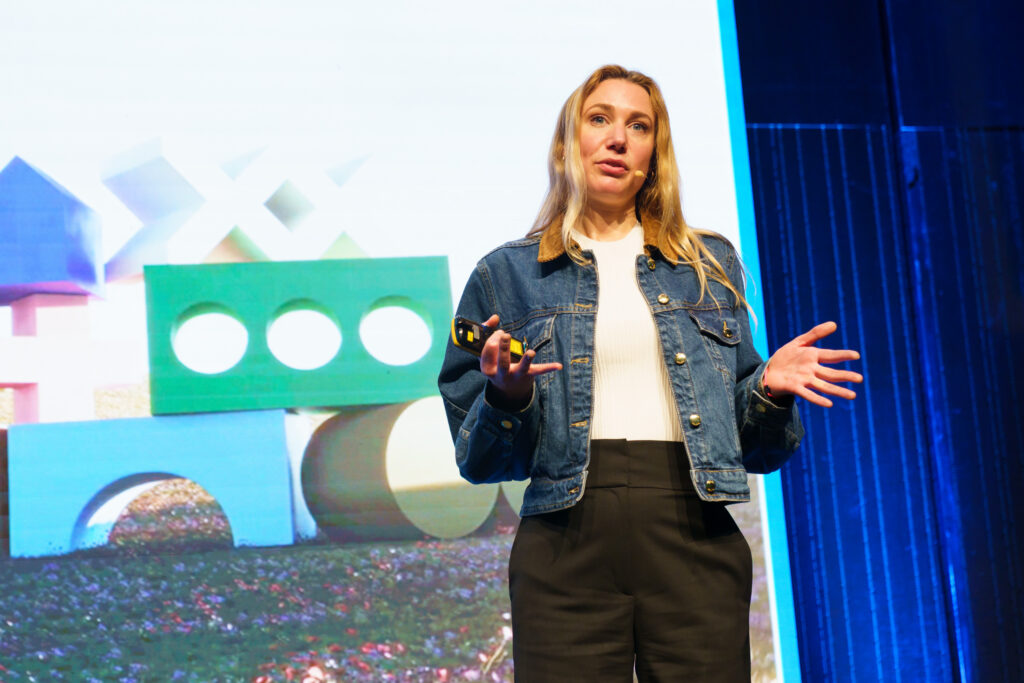
Robina von Stein, Principal at Contrarian Ventures, sharing a keynote on Energy Tech Summit 2025 stage.
Why the software relationship model breaks
In software, scaling largely runs through one relationship: founder and equity investor, milestone to milestone, growth measured in revenue.
Climate tech founders face something considerably more crowded. Alongside equity they depend on debt, project finance, non-dilutive funding and grants. They also have to engage policymakers directly, because so many of these solutions live or die by the regulatory landscape.
That leaves the founder building multi-stakeholder relationships while trying to run a company, and asking a continuous stream of questions nobody has written down in order. Climate Brick exists to structure those questions and, as von Stein put it, remove the friction.
Seven paths, not one
The research base is substantial: over 4,000 companies analysed and more than 100 interviews with founders, investors, policymakers and others across the ecosystem.
The finding was that no single scaling journey exists, but the journeys cluster. Sorted by business model and risk appetite, they resolve into seven distinct routes, each with its own blueprint from pre-seed to IPO: gigascaling, green deployment, asset as a service, product disruption, new technology, moonshot, and companion software.
Each blueprint addresses what a founder actually needs to decide and when. How the financing should be composed at each stage, how much should be non-dilutive against equity and debt, how to structure the team, how to build customer partnerships, even how to structure a letter of intent.
Von Stein was direct about the condition for success: this is a community project, and it only works if people use it. The bricks are downloadable from the website.
What changed in 2025
Grafflin led this year’s edition, and brought an operator’s perspective to it. Before joining EQT Ventures she was COO at an electric hybrid aircraft company, and before that an early joiner at a battery manufacturer – putting her inside two of the seven bricks personally.
Her motivation was concrete. She estimated spending 60–70% of her time fundraising and explaining to prospective customers what building new technology requires of them. If a framework could bring that down toward 30%, the time returned to actually building would be substantial.
On the state of the market, she pushed back on the prevailing narrative. The hype is over, people say. The investment data does not obviously agree – equity rounds this year are up meaningfully on the year before.
What is over, in her reading, is tolerance for optionality. The technologies surviving the next wave are the ones that are business critical. Nice-to-have companies face a much harder time raising.
What investors now expect
Grafflin’s list was the most immediately useful part of the session, and each item was a shift rather than a constant.
Economics without the premium. A financial model resting on subsidies and green premiums has lost its appeal. Products need to be cost-comparable at scale, reach that scale quickly, and perform better than the incumbent to get adopted at all.
Resilience designed in. Portfolio companies once relocated to the US for policy reasons; that calculation now carries far more uncertainty. Building resilience into the business model has to be structural rather than an afterthought.
Execution capability, deep in the org. A team that has never industrialised anything lowers the odds of getting funded. That applies at C-level and equally to middle management, the people who actually run industrialization.
Boards that do more than finance. This was her sharpest point, and it was aimed at her own side of the table. Drawing on frustration from her operating years, she described investors taking board seats and then wanting to discuss only fundraising and financing. Boards need the right person in the right seat, with industrialization capability present through decision-making and execution.
Late-stage financing, planned early. Saying the later rounds will be sorted out later no longer works. A business plan needs a clear path to being fully funded across debt, grants and equity. Relying on equity alone in a capital-intensive company was never viable, and there is now far more experience in the market about what project financing actually requires. Customers, meanwhile, have grown more cautious about signing large offtake contracts.
Finding your brick
A common piece of feedback was that founders could not tell which brick applied to them. The new site answers that with a tool where a founder enters a URL and gets matched.
Grafflin demonstrated it live on a fusion company appearing later in the programme, which came back as a moonshot. She also noted that belonging to two or three bricks at once is common, and that navigating between them is part of the work.
The part that isn’t a document
Both speakers closed on the same argument: the framework is the smaller half. The community around it matters more.
Grafflin was specific about who needs it most. Many climate tech founders are young and first-time, often straight out of university with a strong idea and no network at all. How does a founder building a recycling company meet someone in the relevant supply chain? How do they reach the decision-maker at a potential customer?
Her ask of the room was for network creation rather than capital. These companies are not built on equity alone, and the whole ecosystem – including corporate venture arms – has to contribute.
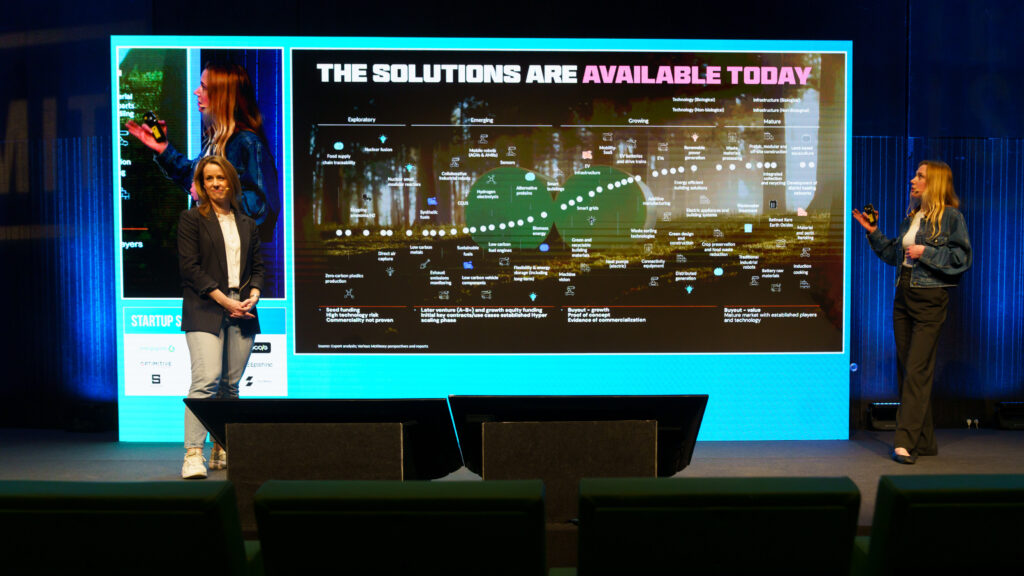
Climate brick 2025 launch: how to scale climate tech companies from pre-seed to IPO — a blueprint keynote at ETS2025.
Takeaway
Scaling climate tech has been treated as a financing problem with a venture-shaped answer, and this session’s argument is that the shape is wrong. Seven routes exist rather than one, the capital comes from four or five sources rather than one, and the hardest constraints are often industrialization talent and network access rather than money. The 2025 message is narrower and less comfortable than the 2024 one: build something the customer would buy anyway, and know how the last round gets funded before you raise the first.
Secure your pass
Energy Tech Summit brings together the startups, investors and corporates building the energy transition. Founder’s Pass is €699, fixed.