A fusion company has no product to sell until roughly 2030. Marvel Fusion’s CFO explains how to show investors progress when the milestones are physics, not growth.
Funding deep tech in Asia-Pacific leans harder on the state than most places. Government programmes, sovereign funds, and national research agencies carry early risk across China, Japan, Korea, and increasingly Southeast Asia. Meanwhile, several of the region’s markets run fusion programmes of their own. So the sequencing question below isn’t a European curiosity. It describes how investors actually finance a great deal of hard technology here.
Why the Software Pattern Breaks
Funding deep tech breaks the pattern investors learned to expect. Software moves milestone to milestone, and measures each one in revenue growth. A fusion company has no revenue until the technology works and a plant exists, which may be a decade out. Even so, it has to raise capital every year in between.
Rokas Peciulaitis, Founder and Managing Partner at Contrarian Ventures, put that problem to Nicolas Burkardt, CFO at Marvel Fusion, in a fireside chat at Energy Tech Summit 2025. Burkardt had just closed a Series B, which made him a useful person to ask. The conversation followed the launch of Climate Brick, the scaling framework Contrarian Ventures runs with EQT Ventures. Burkardt used its structure to explain his own journey.
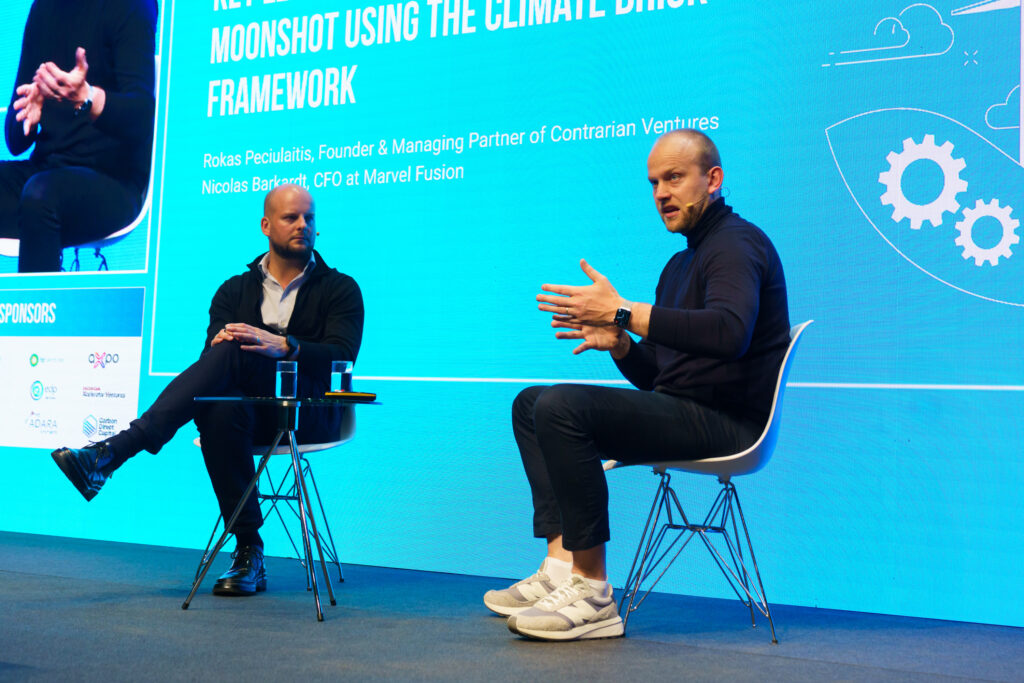
Rokas Peciulaitis and Nicolas Burkardt speaking at Energy Tech Summit 2025
Why Fusion, and Why Now
Burkardt began with an argument about prosperity rather than emissions. Energy underpins productivity. Without rising productivity, Europe struggles to finance its social systems, and ends up scaling back its ambitions. Availability of energy, on this framing, is an economic question rather than an environmental one.
Fusion’s appeal is its profile. It’s safe, clean, effectively inexhaustible, and dispatchable around the clock, and it produces heat alongside electricity. A very small quantity of fuel runs a plant for a year. Burkardt cited 360 kg of fuel annually for a 500 MW plant operating roughly 8,000 hours, and a target LCOE below €50 per MWh.
Two Technologies, One Bet
The technology underneath the funding deep tech question rests on two components. The first is extremely thin nanostructured targets, rods measured in microns and nanometres. Twenty years ago, nobody could have manufactured these; today, they can. The second is short-pulse diode-pumped laser systems, developed with partners, which fire at those targets to ignite them.
Burkardt’s confidence rests on efficiency claims for both halves. The laser mitigates internal energy losses, and the target technology is the company’s own invention. The company has tested both subscale in existing infrastructure, where the physics drivers behaved as simulated.
Funding Deep Tech Means Breaking a Moonshot Into Risks
The core of the conversation was Peciulaitis asking how a CFO dissects a decade-long journey into pieces capital can price. Burkardt’s answer was a sequence of distinct risks, each unlocked in order.
Science comes first. That means proving physics drivers not previously demonstrated actually work. Technology comes second, which means identifying what must scale, and building partner confidence in the roadmap. For Marvel, the thing that must scale is the laser.
Third is the plant itself, which he framed bluntly as a partners game rather than a solo effort. It requires the right reputations and the right assets.
Fourth is offtake. Who takes the energy, and can an early offtake structure unlock further capital? This is where a telecoms group came in, motivated by data centre demand and interested in baseload fusion power. Burkardt cited US data centre electricity demand rising from 100 TWh to 500 TWh by 2030, with similar trends in Europe.
Fifth is the investor base itself, matched to stage. Strategic investors make no sense in a seed round. That stage needs knowledgeable deep tech investors willing to carry the risk. Only later does the capital base widen.
Public Money as the Unlock
Peciulaitis named the mechanism he sees repeatedly when funding deep tech. Public funding acts as the first-loss layer that makes private capital possible.
Burkardt confirmed it directly. Growth-stage funds coming into the Series B needed government backing to be there, because the total required through the end of 2028 exceeds what European venture capital, family offices, and strategics could supply alone.
So the company assembled public support first. German government funding covered the laser. University and Department of Energy funding in the US then covered the infrastructure to test and commission it. With that in place, the remaining private raise became comparatively small relative to the milestone it buys.
He described this explicitly as a pattern to repeat: use anticipated government support as a matching facility to attract the next round.
When Letters Stop Meaning Anything
When funding deep tech, Peciulaitis observed, round labels stop meaning much. Burkardt agreed. What matters is which milestone the money buys, not whether the letter is B, C, or D.
Burkardt added momentum as a second variable. Having just closed, he was already fielding approaches. He didn’t rule out extending the round rather than waiting for a formal next one.
His answer on the hardest part of the job was about patience, and it cut against his own interest. People are naturally impatient. Even so, he argued investors should take the time to build genuine confidence before committing. Deep tech brings problems that investors and founders solve jointly. Fundraising taking longer is therefore acceptable, if it produces backers who will carry the company through subsequent rounds.
Burkardt said the team would test the laser this year, with proof of technology by the end of next year. The company is targeting energy gain for 2028, and a first power plant with Siemens Energy in roughly a decade.
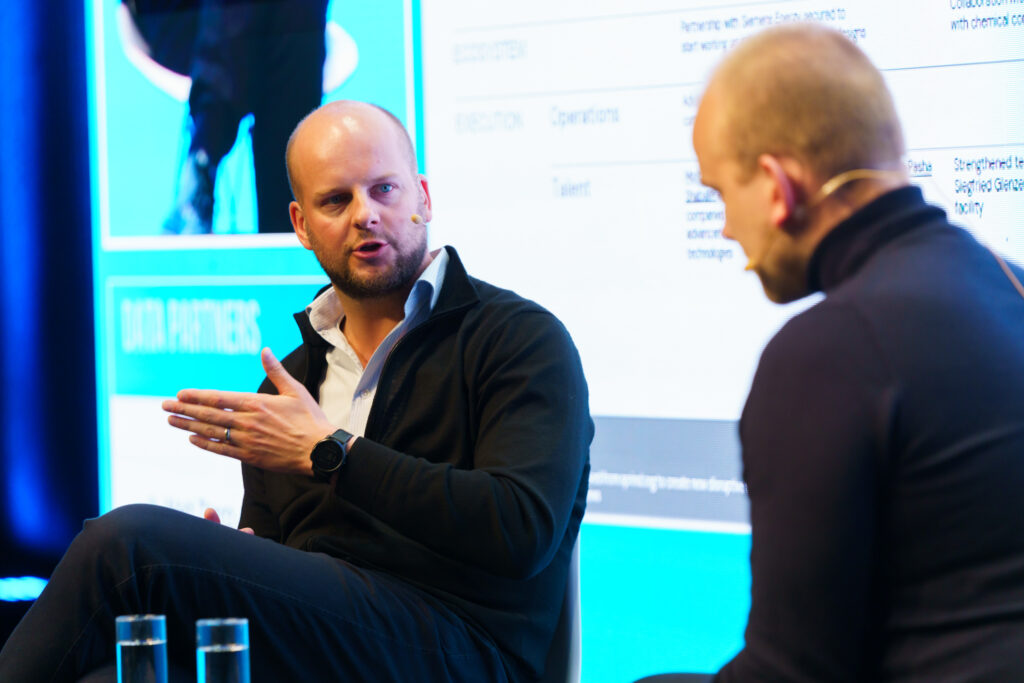
Rokas Peciulaitis, Founder and Managing Partner at Contrarian Ventures speaking during Energy Tech Summit 2025
Takeaway
Funding deep tech is a sequencing problem more than a persuasion problem. There’s no revenue to point at. So the company has to convert a decade-long moonshot into an ordered list of risks, then retire them one at a time, matching each to the kind of capital willing to price it. Public money goes first and does the de-risking. Growth equity follows the government signal rather than leading it. Corporate balance sheets arrive when there’s something to offtake. And the round letters end up describing the calendar rather than the company.
Energy Tech Summit Asia comes to Kuala Lumpur on September 29–30, where public capital and first-of-a-kind projects sit on the agenda.