Long-term planning, cheap electricity and a domestic market. A think tank analyst and two investors unpack how China got ahead, and where the margins now sit.
Read this one from Asia and the geometry changes. China’s cleantech surge is not a distant competitive threat here. It is the neighbouring supply chain, the source of cheap panels and cells, and increasingly the partner in regional projects. So the lessons below were aimed at Europe and the US. Several of them describe what parts of Southeast Asia are already inside.
A case study, not a threat
China’s cleantech surge is usually discussed as a threat. On the Energy Tech Summit 2025 stage, the panel refused that framing and treated it as a case study instead. Bianca Dragomir, Director at Cleantech for Iberia, opened by asking the room to switch into learning mode. Not confrontation, but reflection followed by action.

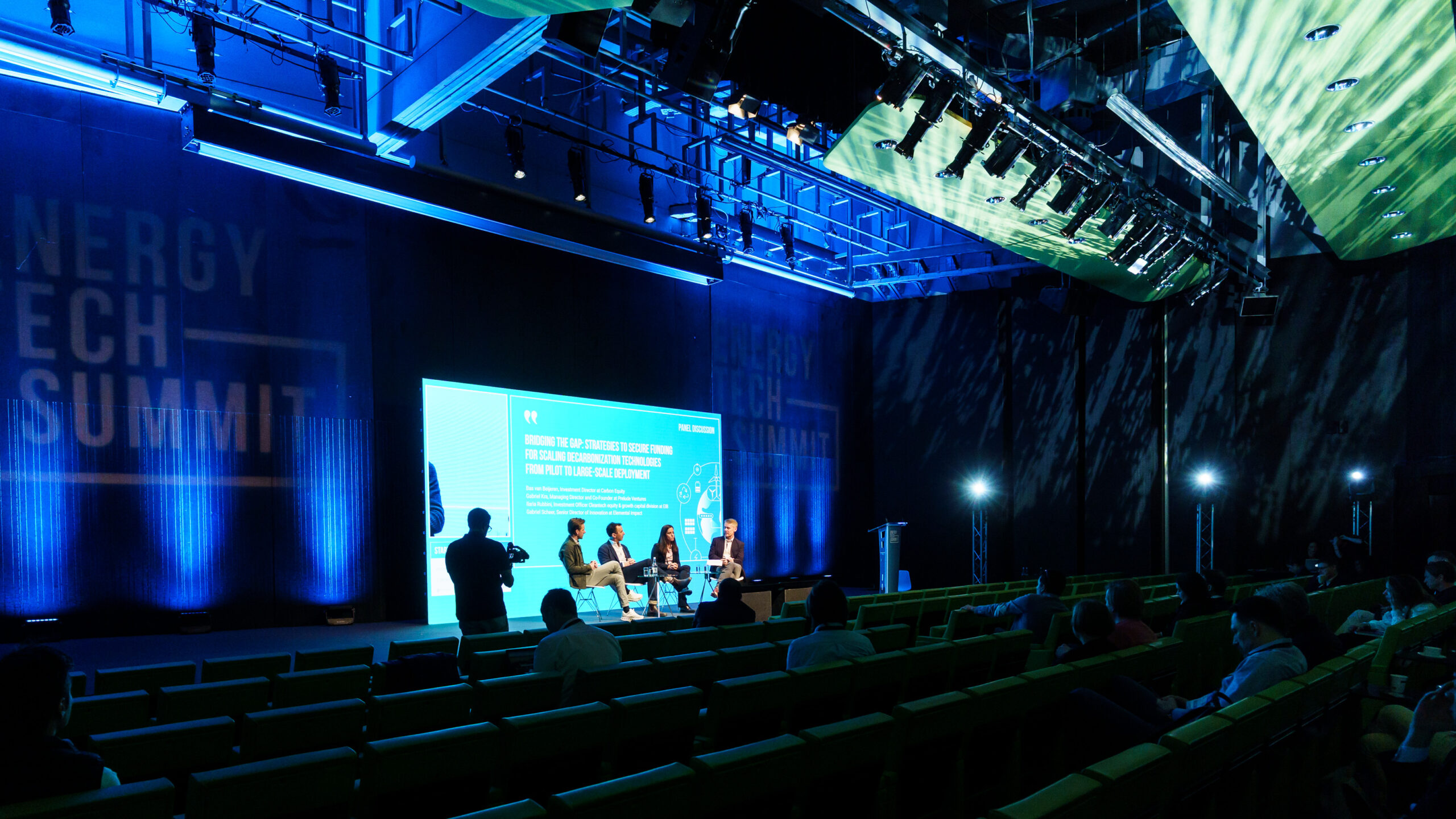
Bianca Dragomir, Director at Cleantech for Iberia, moderating a panel session on China’s clean-tech surge.
What made China’s cleantech surge possible
Hetsch gave a one-line answer. “The short answer for China I would say is long-term planning.”
Solar illustrates it. The industry belonged to Germany, the wider West and the United States until China set its mind on it. Then came silicon production, panel manufacturing, and a large domestic market to absorb the output. Exports to everyone else followed.
Electric vehicles may illustrate it better. Catching up on the combustion engine looked hard, since the technology was already fully engineered. So China leapfrogged instead. It put its research and development resources behind EVs, secured raw material access and built brands. Being the challenger even helped, because it left room to compete on software and usability.
Underneath both examples sits the same structural point. A state can commit every resource once it decides. It also does not face a possible policy reversal every four years.
Hero or villain? The panel declined the choice
Dragomir asked directly whether China is hero or villain. Nobody took the bait.
Hetsch turned it around. “If a country is providing you with cheap clean electricity”, why refuse? Imagine instead a world where fossil fuels remained the cheapest option. That conversation would be far worse.
Saharova agreed, pointing to commitment and capital allocation at scale behind explicit five- and ten-year plans. Her conclusion was direct. “We should not be demonizing them but we should actually learn from them.” She noted that around 10% of Chinese GDP now comes from cleantech.
Walter reframed it philosophically. China has already had the conversations the West is only starting. Energy is a tool of geopolitical power, not just electrons. The narrative there has centred on energy independence, economic growth and dominance for two decades.
Morals, economics and the Model T
The morality of China’s cleantech surge led to the sharpest exchange of the session. “We’ve been doing moral things for moral reasons,” Walter said, “and that’s really good.” Yet a strong case now exists for acting without the morals, and China has made it for over a decade. Follow it, he argued, and you “not only do the right thing but also make a hell of a lot of money”.
His analogy came from New York. Horses filled the streets, then a decade later Model Ts did. Nobody removed the horse by taxing manure. Ford simply built a better car and scaled it fast. Only once cars dominated traffic did politicians find it easy to make the moral case about leaving manure outside a neighbour’s door.
Morals therefore return later in a transition, probably to squeeze out the final fraction of fossil demand. Economics, meanwhile, moves the majority in between.
Saharova added that morals are regional constructs. They look different in China or Brazil than on a European stage. Hetsch went further still. Europe enjoyed decades of selling high-margin products, buying cheap Russian gas and relying on American security. “Maybe it was not so much European moral, maybe it was just European arrogance.”
The gap between patent and product
Set against China’s cleantech surge, Europe’s weakness is not invention. Saharova pointed to the patent record and the sheer number of European startups working across cleantech verticals. Dragomir named the gap precisely: strong early-stage innovation, weak scale-up.
Hetsch doubted that Europe can copy the planning model, since uniting many countries behind one goal remains structurally hard. What Europe could copy is the input underpinning everything else. That means access to cheap electricity, combined with a mobilizable workforce and a large market. He also noted that the relevant bloc is no longer China alone, but China plus Malaysia and Vietnam.
Saharova’s ask was blunter. Act on what has already been said for years. The narrative around European energy sovereignty is not new, and neither is the data. “We know what to do.”
On the Clean Industrial Deal, Dragomir cited €100 billion mobilized with de-risking and guarantees. Saharova argued required investment runs far higher, citing 590% more per year and a figure of around €4 trillion. The transcript does not make clear whether that number is European or global.
The forgotten vector: electrification
Walter then named the vector missing from most readings of China’s cleantech surge. The West has practised system thinking almost entirely inside the carbon column. Suppliers can describe a distant supplier’s boiler for scope 3 purposes, yet cannot describe their own exposure to imported gas.
Meanwhile the second vector of change stalled. Renewables entered the power system successfully, but electrification of society flatlined around 2008 and has barely moved since. That is not because everything electrifiable is electrified. China overtook the West on electrification, and so did several developing economies.
The energy security numbers make the point harder still. Walter put imported energy at 74% of consumption in Spain and 67% in Germany, against 20% in China. Around 80% of import spending, he added, goes to final consumption. That means oil and gas for vehicles and industry, rather than power.
Hence his single recommendation, echoing Hetsch. Lower the electricity price. It serves growth, decarbonization and energy security at once. Subsidising clean generation while pushing electricity prices up, by contrast, defeats the purpose.
Where the margins actually sit
Asked where the West can still win against China’s cleantech surge, Walter advised against skating to the puck. “Europe has a tendency to skate towards where the puck is, not towards where the puck is going.”
Software is the clearest example. The solar panel market is enormous but returns thin margins. Energy management software is smaller and vastly more profitable. So the money in this transition may not go to whoever builds the device. “Not the iPhone but the iOS.”
Walter sized the solar panel market at roughly $63 billion a year on 1 to 1.5% margins, against about $40 billion in energy management software at 70 to 80% margins.
Saharova pushed beyond software. Europe lost the volume EV race, yet high-performance cells remain open, with real companies and real supply chains behind them. Everything gets electrified eventually, including defence and medical devices. Those products carry high margins. She cited World Fund’s investment in CustomCells, a Fraunhofer spin-off, and referenced the firm’s €300 million climate tech fund.
Battery recycling drew agreement from both. Let the mining and first manufacturing round happen elsewhere, pull the material in, then recycle and remanufacture it locally. Ember’s analysis suggests a properly built recycling system could make Europe mineral-independent within roughly two decades. That removes the long-term dependency entirely.

ETS2025 speaker – Daria Saharova, General Partner at World Fund, sharing her insights on stage.
Alliances, APAC and the global south
On strategic alliances, Saharova started at home. Global partnerships matter. Even so, misalignment between member states and bureaucracy have done more to slow Europe than any external competitor.
Hetsch described how this already shapes investment. Companies run first pilots in Europe or the US, where engineering talent, universities and a favourable environment sit. Then they scale in APAC, for integrated supply chains, component costs and market size. Each region plays to its strength, and some dependency always remains.
Walter widened the frame again. The global south is rising fast, buying cheap power quickly and becoming China’s largest export market. Europe cannot compete on manufacturing today. Protecting the home market, moreover, will not save European exporters that need global revenue.
So the strategy has to be selective. Western software and western capital markets still command trust, and both remain advantages worth using. “We should probably stop focusing on all the things we cannot do and start focusing on the things we can do.”
Takeaway
China’s cleantech surge is not an anomaly. The panel treated it as the product of planning, capital alignment and cheap power rather than of luck. Europe already holds the research, the patents and the startups. What it lacks is scale-up, electrification and internal alignment. The practical lessons were narrow and repeatable. Lower electricity prices. Invest where margins actually sit. Build recycling now, rather than chase mining later. Read from Asia, the same list reads less like advice and more like a description of what the region is already assembling.
Energy Tech Summit Asia comes to Kuala Lumpur on September 29–30, where China’s role in the regional transition is on the agenda.