Remove the upfront cost and adoption accelerates. Remove it carelessly and you finance someone else’s equipment for a decade. Four investors on where the line sits.
Climate technology rarely competes on software economics. It competes on capex, often against an incumbent that is already installed and paid for. When a better solution costs more upfront, that upfront cost becomes the adoption barrier — not the technology itself.
That is the gap asset-as-a-service is meant to close. A panel at Energy Tech Summit examined how well it does so. It was moderated by Vikram Raju, who leads a growth-stage climate fund at Morgan Stanley. Joining him were Michelle Capiod, Co-founding Partner at Blume Equity; Raphael Cattan, Investment Director at Eurazeo; and Frederik Simoens, Investment Director for Energy Transition at Korys.
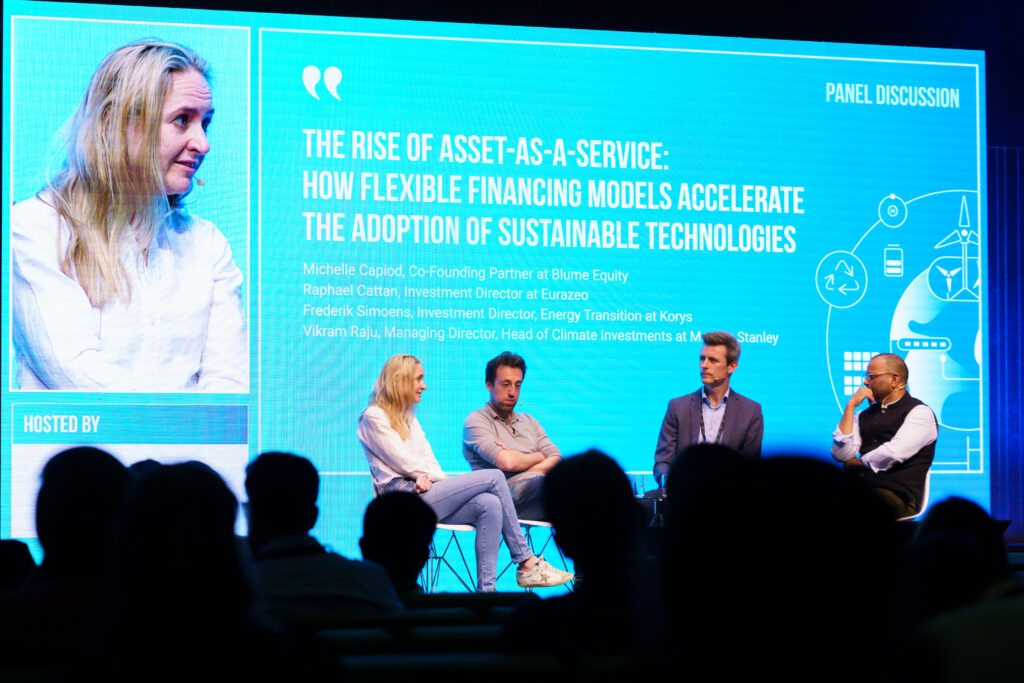
Vikram Raju, Michelle Capiod, Raphael Cattan, Frederik Simoens during ETS2025 panel session
The problem asset-as-a-service actually solves
Cattan framed it in terms of adoption loops. Climate solutions involve real capex with large upfront costs, and customers replacing fossil fuel equipment do not always have that budget. Performance matters, but so does simplicity and the absence of a large cheque at the start.
His example was a UK company building ground source heat pump networks. These serve developments where many homes, or a campus or hospital, are built at once. Ground source is considerably more efficient than air source, and considerably more expensive. The company’s move was to find a financing partner to carry the upfront capex instead of the real estate developer. The development gets cheaper, and the future occupants pay a monthly bill much as they would have paid for gas. Secure long-term revenues make that financing possible.
Simoens made the parallel case for commercial and industrial customers. Plenty of companies know they could optimise energy consumption and footprint. But they have neither the expertise nor the appetite to deploy capital outside their actual business. A turnkey offer covering batteries, solar and sometimes heat, optimised on their behalf, is straightforwardly attractive. Someone else charges the battery at the right moment and discharges it at another. No capital or knowledge investment is required.
An old model with new conditions
Capiod pushed back on the novelty. Asset-as-a-service dates to the 1960s, when Rolls-Royce introduced power by the hour in aviation — effectively renting engine hours to airlines. There was considerable hype at the time about it becoming the next big thing. A number of hurdles kept it from taking off broadly.
What has changed is the surrounding conditions. Technology innovation, pressure to use resources efficiently, and regulatory momentum around the circular economy all favour the model now. The persistent difficulty is unchanged: getting customers to understand who bears which risk, and working out who is genuinely best placed to obtain financing at the lowest cost of capital.
She pointed to battery storage as the most interesting proving ground. Companies here are bypassing traditional banks entirely. Some have gone to pension funds with a relatively low cost of capital, set up fund structures to finance the capex, and layered a subscription model for end customers on top. The underlying trick is separating the asset, which wants cheap patient capital, from the data and services layer, which is where the upside actually sits.
Where the model breaks: the economics have to hold
Raju pressed the panel on failure modes, and the answers were specific.
Simoens started with the model itself. If you offer a service, the numbers have to hold over the contract’s life, not just at signature. He was direct about flexibility revenues: prices have been elevated and may remain so in some markets, but they can equally fall. A financing model that depends on them is fragile. Better to build on the fundamental rather than the price. With renewables there will be oversupply at some times and undersupply at others, and bridging that gap will remain valuable regardless of what any particular price does.
His second warning concerned differentiation. Anyone can buy assets, finance them, and offer them as a service. What matters is what you do with the assets once deployed. Without technology that genuinely optimises their use, and earns more from them than a competitor would, the model becomes a race to the bottom.
Where the model breaks: customers aren’t always ready
Capiod added customer readiness, which bites hardest in B2B. Moving a purchase from capex to opex often shifts it to a different set of people, with different approval levels and different budget holders. On the headline the logic is compelling, particularly when the innovative solution is pricier than the incumbent and a small budget can break ground. Underneath, several departments have to be ready for it.
Then comes the trap she called out most sharply. Recurring revenue and long-term contracts tell a wonderful story, and investors love them. But someone has to fund the assets. A company can find itself unable to meet demand because it lacks the capital to source what it has already sold. Being a victim of your own success goes down badly with customers. Financing partners need to be in place early enough to scale with demand.
Where the model breaks: the fine print in the contract
Cattan’s contribution was the detail underneath the contract. In an energy service company model, where the provider funds new lighting or HVAC and earns from the resulting savings, everything depends on how a saving is defined. Which baseline year applies, and whether the customer keeps accepting that definition or eventually renegotiates. Similar tension arises when a customer pays a fixed fee while the provider’s flexibility revenues shrink because the market has become crowded.
Small assets and consumers are the hard case
Asked where the model does not work, the panel agreed quickly. Asset financiers dislike small assets. Cattan described an e-bike subscription business in the portfolio, where individual assets cost around a thousand euros.
Simoens framed the same point as an investment question. Batteries at a company site or a full solar roof are assets in a stable location. Something placed with a consumer is far riskier, since you never quite know what will happen to it. That makes it less bankable if you want to leverage it.
Capiod added the financing arc that follows. Longer contracts improve bankability and lower the cost of debt, but there is always a chicken-and-egg problem. Until a business reaches minimum scale with years of performance data, traditional banks struggle to underwrite it. Equity therefore funds the early journey, and the transition to debt has to be planned deliberately. That includes being explicit from the outset about who carries which risk, including service level commitments such as uptime. It also means deciding whether a special purpose vehicle owns the assets on the company’s behalf while the operator takes a portion of the monthly payment.
Regulation can move the ground under you
Cattan flagged a risk founders rarely model. If a product depends on subsidies, the subsidy rules may not treat leasing and ownership equally. Regulators do not always consider service models when drafting.
He cited German solar, where leasing was previously favourable. Rule changes have since made subsidy access more complicated for anyone who does not own the asset. Workarounds usually exist, but they add friction. VAT is another example, since some countries apply different rates depending on whether the customer buys the asset or uses it under another arrangement.
Capiod closed the risk discussion on usage-based pricing. Paying only for what you use is enormously attractive to a customer, but it transfers volatility to the provider. If usage falls and there is funding behind the assets, the provider absorbs that swing. The trade-off between accelerating sales and retaining risk sits at the centre of the model.
Watch the cost curve
Capiod named falling prices as the question she asks most as an investor. Solar panel prices have dropped substantially over recent years. If you buy an asset at one price and lease it over a long period while the replacement price collapses, you may be unable to lease it at your original price point. In that scenario, selling the asset outright would have been the lower-risk choice.
Any rapidly evolving industry with a steeply falling cost curve deserves that scrutiny before a leasing model is locked in. Cattan expected battery and solar prices to keep falling. That’s welcome for the energy transition, and considerably less welcome for European manufacturers.
Mapping the road to bankability
Cattan’s practical advice for founders was to define the milestones that lead to bankability. Find investors who help map that journey rather than simply funding it.
The sequence usually starts with equity financing the first assets. Venture debt can complement that, though he was careful here: it is expensive and risky, a reasonable starter but not something to continue indefinitely. Because these are innovative products with little market precedent, the real work is talking to the people who will eventually provide asset finance. Understand what they need to see: asset profitability, customer bankability, counterparty risk, and what loan-to-value is realistically achievable.
That homework is exactly what equity investors examine at Series A and B. Doing it early is doubly worthwhile.
Beyond energy
Asked for the most unusual service model they had encountered, the panel went well outside the sector.
Capiod pointed to mobility as the area with the most historical traction from a venture perspective, covering usage-based EVs and scooters. She suggested agriculture as a natural next step, with equipment rented to farmers moving towards regenerative practices. Blume is also looking at something in food production involving equipment that substantially increases efficiency, which she could not yet discuss.
Simoens offered the most concrete example of bundling done well. EV leasing is not new, but some providers now deliver the energy alongside the vehicle. They optimise charging in the background, shifting it to low-price periods and potentially using the car as a battery in flexibility markets. Because they capture that value, they can offer an all-inclusive package priced per kilometre that beats buying leasing, energy and maintenance separately.
Cattan described an adjacent structure rather than a pure service model. Eurazeo has invested equity in building an automated farm, combining a greenhouse with robotics to automate as much of the work as possible. Mixing crops rather than repeating a single culture keeps soil fertile and lifts yield, but it is normally far too labour-intensive to be viable. Automation is what makes the economics work.
His broader observation was that infrastructure investors are increasingly willing to take more risk once a first or second project has proven out. That willingness is part of what makes asset-as-a-service models financeable at all.
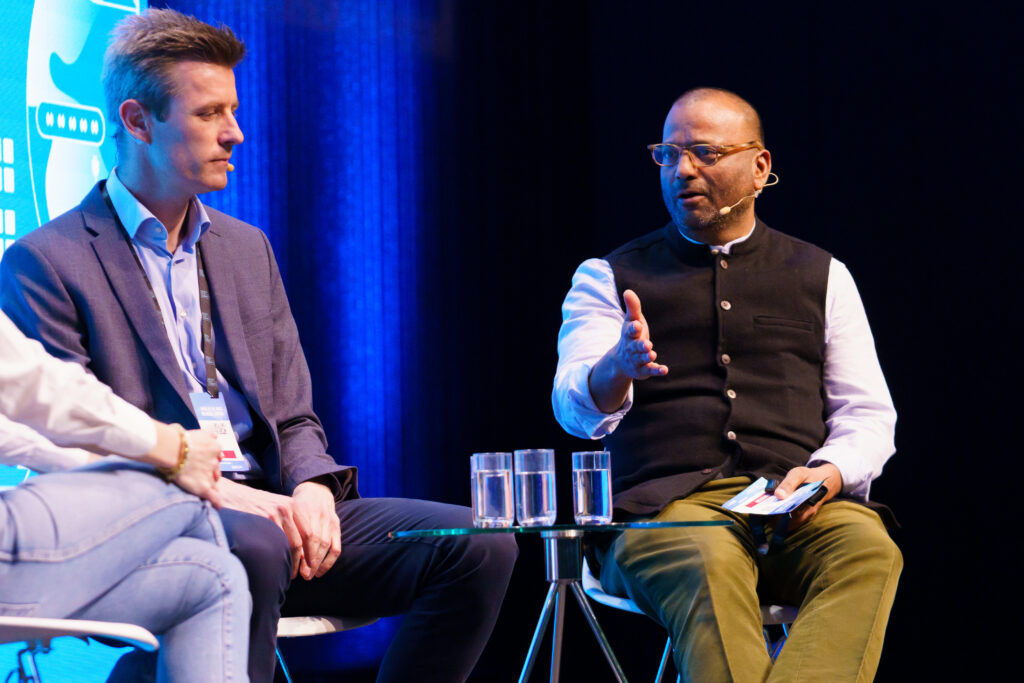
Vikram Raju, Managing Director, Head of Climate Investments at Morgan Stanley, moderating an expert panel at ETS2025
Key takeaway
Asset-as-a-service works when it removes a genuine adoption barrier and the provider adds value beyond simply owning the equipment. It fails when the model rests on price assumptions that do not hold, when the assets are too small or too mobile to finance, when regulation treats users differently from owners, or when demand outruns the capital available to serve it. The model is not new. The discipline required to make it work is what separates a scalable business from a slow way of buying someone else’s equipment.
Secure your pass
Energy Tech Summit Europe returns to Bilbao on 7–8 April 2027, bringing together the investors and founders building new financing models for climate technology.