90 billion of dry powder, deal counts at a four-year low, and European funds closing at twice the US rate.
Asia builds a great deal of the world’s clean energy, yet it forms comparatively little of the capital that funds it. That gap is the region’s live question. Foreign investors keep asking whether Asia’s energy transition actually pays, while deployment races ahead of fund formation. So knowing where climate tech investment concentrates globally matters here. It tells you which arguments will work when the capital comes looking.
Plenty of dry powder, fewer deals
Charles Bondu, Lead Technology Analyst at Sightline Climate, closed the keynote programme at Energy Tech Summit 2026 with a preview of the company’s annual dry powder and new funds report. Sightline tracks investment flows, projects and signals. Its purpose is establishing where capital is going, what is being built, and what comes next in climate and energy tech.
He began with good news. Climate tech investment does not lack capital.
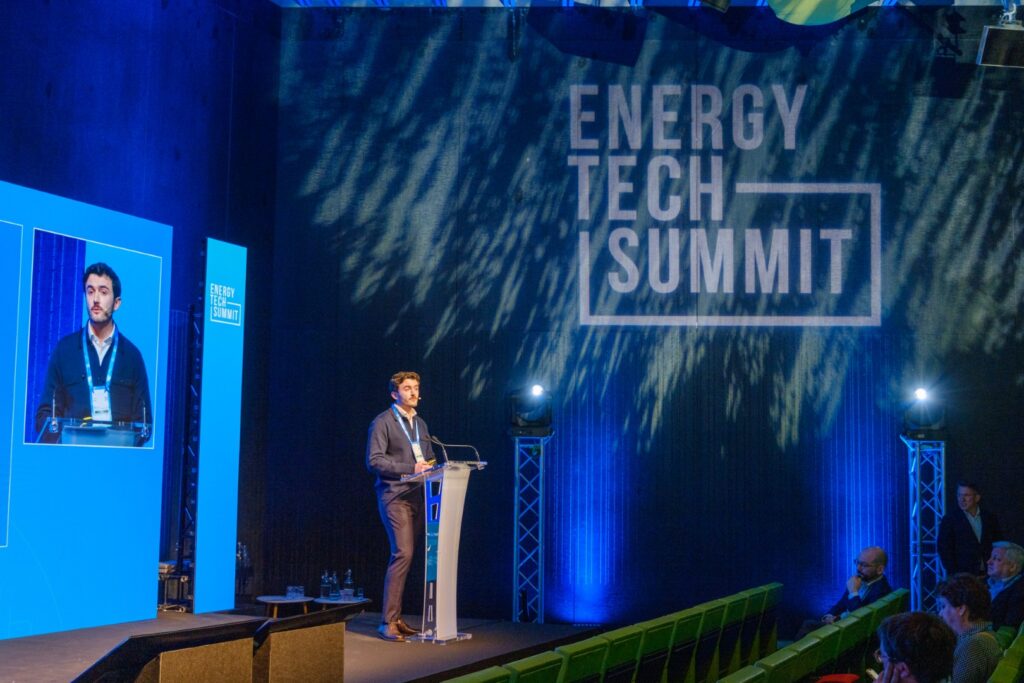
Charles Bondu, Lead Technology Analyst at Sightline Climate speaking at Energy Tech Summit 2026
As of the first quarter, Sightline calculates $90 billion available for deployment across the capital stack. That follows a record 2025 that peaked above $100 billion. Moreover, deployment of that capital is rising.
Funding across verticals rose 10% last year, led by energy, which has now cemented its position at the top after overtaking transportation in 2024.However, deployment has not kept pace with deal counts, which fell to a four-year low. Consequently, the market is seeing considerably larger individual deals. That combination, Bondu argued, makes this a distinctive moment for climate tech investment.
From it, he drew three themes for the year ahead.
Theme one: the rise of Europe
In an uncertain geopolitical environment, the world is looking to Europe for climate leadership. That is showing up in where capital forms and where investment lands.
Europe beat every other region on the number of climate tech investments last year, with continuous funding across energy, transportation, industry, food and land use, carbon and climate management.
Fund formation is the leading indicator of that shift. Europe now accounts for over half of new funds by value and more than 40% by count.
Importantly, these are not first-time climate investors. Bondu named repeat players raising their third, fourth or fifth funds for energy and climate tech. They have demonstrated returns, so their institutional investors are returning with more capital.
Why European funds actually close
The most striking figures in the presentation concerned fund closes rather than fund launches.
Last year, European funds closed at an average 71% of their fundraising target. The US close rate was just 35%, down from around 80% five years earlier.
Close rates everywhere have fallen from above 90% during the post-pandemic recovery boom. Nevertheless, European fundraising has been considerably less volatile than American.
Bondu attributed that largely to policy backing, which gives innovators confidence they can deploy and compete. Europe’s carbon border adjustment mechanism and its emissions trading systems will materially affect the price of imported aluminium, cement, ammonia and steel.
As those mechanisms phase in, they should drive low-carbon technology projects. They should also improve the competitive position of European industrials. Suppliers are already lining up to serve that demand, with projects advancing on the back of European offtakes in low-carbon ammonia and sustainable aviation fuel. The price signal, in short, is what makes those projects bankable.
Theme two: back to basics
Bondu’s second theme reframed what investors are actually buying, and it started with a historical correction.
The original driving force behind nuclear, solar and wind was not emissions reduction. It was the idea that countries could produce energy domestically and make their supply chains resilient in a crisis.
Those same themes now recur throughout the largest deals. Broken down, the biggest transactions of 2025 sort into energy security and system resilience.
Nuclear is the ultimate energy security play. The single largest deal was a Chinese state investment of 1.6 billion into a domestic fusion spinout, as the country attempts to establish dominance and compete with American players. Meanwhile, small modular reactor developers are promising clean, firm, scalable power for data centers.
System resilience splits into two stories. One approach makes consumers resilient to interruptions, by installing storage and operating it as a virtual power plant. The other reinforces the grid centrally through deployed storage.
Both approaches mean building more physical infrastructure, and the funding is arriving for exactly that. Infrastructure funds accounted for 77% of new climate assets under management last year, mostly anchored in the EU and Canada. That money is now ready to flow toward technologies delivering security and resilience.
Theme three: the path forward for innovation
New technologies, first-of-a-kind projects and startups remain necessary. What changes is their emphasis.
Innovation will focus less on direct emissions reduction, and more on what the system needs now to transition. For a startup, meeting that moment means bringing costs down and increasing energy security.
The concerning signal is at the top of the funnel, which Sightline sees drying up since the middle of last year. Venture funds are not raising capital as fast as they deploy it.
The number of venture and growth funds being raised for climate has held steady at roughly 100. They are not, however, closing at target, particularly in the US, where policy risk has become too significant. That contrast with infrastructure fundraising is stark.
The most active limited partners reflect the same shift. They are development finance institutions, investment banks and corporates thinking about how to compete on power in the age of AI. Moreover, they are prepared to write large tickets.
Where venture money did flow
Even so, several sectors had record venture years. Specifically, those feeding into growth, resilience, returns and lower costs.
Wildfire technology rose 69%, helping utilities prevent the catastrophic damages and costs of recent years.
Grid technologies, which let the system move more power, saw investment rise 12%, with the third quarter of 2025 the best quarter on record.
Distributed energy resources doubled, as consumers recognized that DERs offer more security and flexibility than traditional assets.
Nuclear stood out most of all, with investment tripling as countries race to deploy next generation reactors faster.
How a novel technology gets funded anyway
More infrastructure funding does not shut novel technologies out, Bondu argued. Investors are becoming more ambitious about risk, and new instruments are helping technologies reach commercialization.
His worked example was a synthetic aviation fuel plant due to open next year in Texas. What made it fundable was that every piece was in place.
It has a trusted supply chain, with established partners supplying both electrolyzers and power. It also has policy mandates creating demand for sustainable aviation fuel in the UK and EU. That is the same pattern already visible in ammonia, where supply is being built abroad to meet European mandates.
Crucially, it has firm offtakes from major airlines that must comply with those mandates. With those elements assembled, the project secured infrastructure capital from established investors, plus project finance to build its first plant.

Charles Bondu, Lead Technology Analyst at Sightline Climate delivering his keynote at Energy Tech Summit 2026
Takeaway
The numbers Bondu presented tell a coherent story about a market that has changed its mind. Capital is abundant, yet it is concentrating. Fewer deals, larger cheques, and most new climate assets under management sitting in infrastructure funds. That has consequences for anyone raising. Venture funds are struggling to close while infrastructure funds are not. The sectors that did well, meanwhile, were grid, wildfire, distributed energy and nuclear. Each reduces cost or increases security, rather than primarily reducing emissions. His closing advice follows from that. The route to funding a novel technology now runs through the first-of-a-kind playbook, with supply chain, policy mandate and firm offtake assembled before you ask.
Energy Tech Summit Asia comes to Kuala Lumpur on September 29–30, where that capital meets the region doing the building.