Asia-Pacific is where the advanced nuclear question stops being abstract. Some markets already run large fleets. Others are weighing nuclear for the first time. Meanwhile, data center demand is landing on grids nobody planned for it. So the timing question is sharper here than almost anywhere.
Wait for the technology to settle, or move while the terms are still open?
The cost of waiting for clarity
That was the argument in a keynote at Energy Tech Summit 2026. Emily Bolon, Chief Commercial Officer at Blykalla, opened with an observation about behavior rather than technology. This is a period of considerable uncertainty. A great many people, she said, are responding by waiting.
Meanwhile the demand keeps arriving. Bolon cited a projection that data centers will account for roughly a quarter of new energy demand in Europe. A single facility can need 50 to 500 megawatts, which is tens of thousands of households.
Against that, the sidelines are crowded. Some wait for geopolitical clarity. Others wait for regulation, or for cost curves to fall. Her argument was that this loses, for a straightforward reason. By the time clarity arrives, somebody has already taken the value.
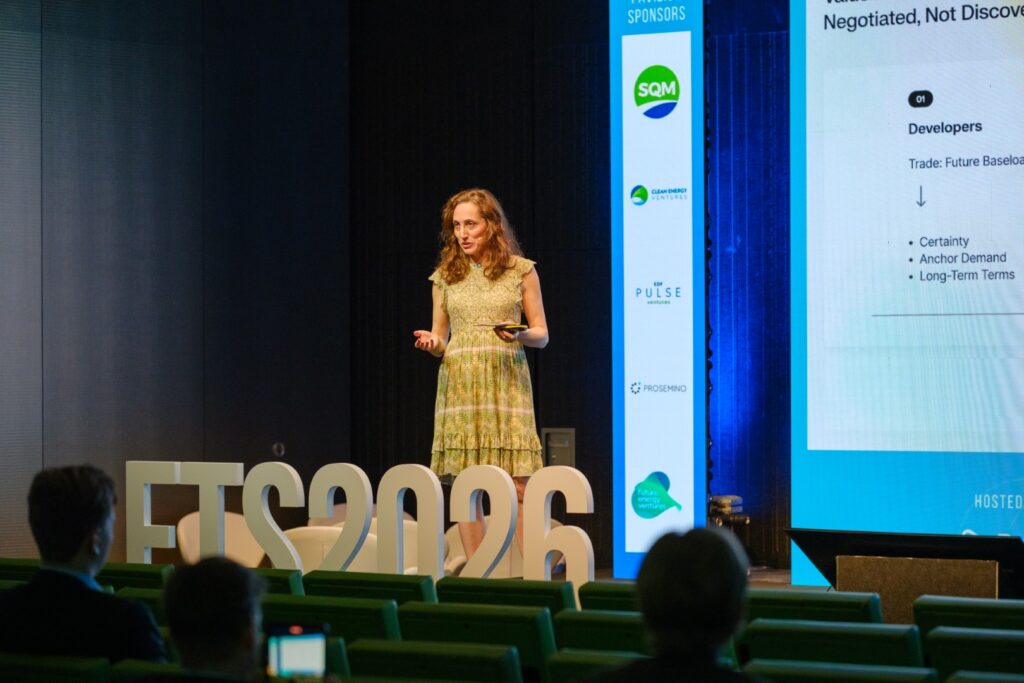
Emily Bolon, Chief Commercial Officer of Blykalla delivering her keynote at Energy Tech Summit 2026
Bolon was careful to separate the technology from its reputation. Advanced nuclear is not the nuclear of the past. Generation IV designs differ fundamentally in their engineering.
The example she used is her own company’s approach. Blykalla uses lead as a coolant instead of water, replacing a water-cooled system with liquid metal. So the reactor operates at atmospheric pressure rather than under high pressure.
Three consequences follow from that single design choice.
First, build time falls sharply. Bolon put the shift at seven or eight years down to something closer to two.
Second, safety becomes inherent rather than engineered on top. The design is safe by virtue of using lead, not because of systems layered around it.
Third, it enables a closed fuel cycle. That, in turn, makes uranium use considerably more efficient.
Her conclusion from all of this was simple. The technology is moving, and the capability exists. So the question becomes what is actually holding things up.
The real obstacle is coordination, not technology
Bolon’s diagnosis was blunt. What sits behind the waiting is a lack of coordination. Alongside that sit a lack of commercial alignment and a lack of boldness.
That last one matters most. Boldness is what allows those who act strategically to capture value. The value will not sit with those waiting patiently at the sidelines.
A worked example: the hyperscaler who moves first
To make the argument concrete, Bolon set up a scenario. A hyperscaler in Northern Europe faces power demand going through the roof. It also faces grid constraints, volatile prices and pressure to decarbonize.
Conventional wisdom says wait. Wait until advanced nuclear is more proven and more bankable. Wait until somebody else builds first.
Now imagine the hyperscaler thinks differently. It enters a PPA. It co-participates in site development. Perhaps it even comes onto the equity table in some form.
The effects compound. Investors gain confidence. The project moves forward. Regulators, meanwhile, see momentum. Nothing has changed technically, Bolon pointed out, and yet everything has changed commercially.
What the hyperscaler receives in return is twofold. First comes access to future clean baseload power, priced now, before scarcity sets in. Second comes the ability to influence the shape of the development trajectory itself.
The mechanism is worth being precise about. Value appears not because the risks disappeared. Rather, it appears because early movers entered and negotiated differently. Every player holds something others in the system need. So moving early lets you trade what you contribute for disproportionate value.
What each party brings, and what each gets back
Bolon then worked through the three perspectives, starting with her own.
Developers face two main constraints. One is capital and balance sheet. The other is the first-of-a-kind investment they have to fund themselves. Their strength is the one thing nobody else has: supply of scarce, clean, future baseload. So moving early and signing agreements now brings anchor customers and strategic capital.
She acknowledged why developers hesitate. Cost curves for a first-of-a-kind project remain hard to quantify, and the technology is evolving quickly. The problem is what happens if you wait it out. Wait until the risk disappears, and the market sets the terms. Then the developer holds less strategic control. Hence early action and iteration, rather than passivity.
Risk visibility constrains investors. Their strength is the ability to unlock projects by acting early. In return, they get to shape deal structures. They also gain access to the pipeline, plus entry at valuations that will not exist later.
Her illustration came from Blykalla’s partnership with a US small modular reactor developer. That company listed in May 2024 at around $1 billion. By the time of the keynote it stood at roughly $5 billion, a fivefold rise since listing. Going back further, she noted the venture investors who put in five or ten million a decade earlier. Their returns sit on a completely different scale. The point she drew was about position rather than luck. Those returns come from shaping the terms.
What a bold offtaker gets
Offtakers, finally, hear the same advice: wait. Focus on what you can do between now and 2030, rather than thinking about 2031, 2032 and 2033. What a bold offtaker contributes instead is demand certainty. In return, they get price stability, priority access, and a place at the top of the order book. Everyone knows that resource will become scarce.
They also gain influence over siting and project development. Moreover, they can build coalitions that make things happen faster. Bolon summarized the offtaker case in a single line. The cheapest clean energy you will ever get is the one you helped bring into existence.
Negotiation, not risk assessment
The framing device Bolon used came from negotiation theory rather than energy. In the 3D negotiation framework, the second dimension concerns expanding the size of the pie. In other words, you create value before capturing it.
You expand the pie by making trades. You exchange what you are good at for what someone else is good at, so the two of you build something larger jointly. Applied to advanced nuclear, the trades are legible. Developers trade future baseload supply for certainty, anchor demand and long-term terms. Investors trade early capital and credibility for pipeline access, influence and upside. Offtakers, in turn, trade demand certainty for price stability and priority.
Her framing of the title claim followed. Value in advanced nuclear is negotiated rather than discovered.
Bolon acknowledged that some offtakers are already moving boldly, pointing to deal announcements the audience would have seen. Others are taking a wait-and-see approach, which has not yet caught up with them. Even so, she expects the picture to look considerably different in a few years.
The constraint that makes urgency real is the one she closed on. These trades only exist while uncertainty is high. After that, you become a market taker rather than a market maker.

Emily Bolon, Chief Commercial Officer of Blykalla at Energy Tech Summit 2026
Takeaway
Bolon reframed the question the industry keeps asking. The issue is not whether advanced nuclear is ready, or when it will be. It is whether any advantage will be left to claim once it is. Her answer treats uncertainty as the asset rather than the obstacle. The window in which a developer, an investor and an offtaker each hold something the others need is the same window in which nobody can price it precisely. Once the technology is proven and the cost curves settle, the trades stop being available. Then the terms get set by whoever moved while it was still difficult.