
Nine gigawatts of flexible load, a cost curve that finally crossed, and a panel that refused the either-or until forced to pick.
Asia-Pacific rarely gets to treat this as a theoretical choice. Some markets are adding utility-scale capacity at a pace nobody else can match. Others are archipelagos, where distributed generation is not a preference but the only practical option. Meanwhile, rooftop solar has scaled fast enough in several countries to reshape the load curve outright. So utility-scale vs distributed energy is not one debate across the region. Instead, it is a different debate in almost every market.
A panel at Energy Tech Summit 2026 took the same question and dismantled the premise within minutes. Gabriel Kra, Managing Director and Co-Founder of Prelude Ventures, said the group had agreed before walking on stage. This is not one or the other. Both matter, and the interesting questions live in the trade-offs.
Why affordability changed the question
Kra opened with a shift he thinks is underrated. Elections in the US have long turned on the price of gasoline, given the country’s car culture. In the past year, though, several statewide elections turned on the cost of electricity instead. Now it is influencing national politics. He called that a sea change, and thought the dynamics in Europe were similar.
The consequence matters for anyone building in this space. Decarbonization and cost often pull against each other. Where they do, the industry’s answers today may differ from its answers two or three years ago. Political pressure and consumer advocacy have moved the ground underneath.
His second framing point was the grid itself. Whatever the balance between utility-scale and distributed assets, the grid still delivers the lights, the hot coffee and the air conditioning. It also delivers EVs, heat pumps and data centers. So the real question is what enhances it. He also noted that distributed assets have historically gone badly underused. Partly the reasons are technical. Partly they are regulatory, because grid operators have to recognize those assets as a resource in the first place.
Who was on stage
Phillip Twiddy is Head of Strategy and Transactions for the demand side at LCP Delta. The consultancy spans generation, storage, networks and demand. It provides research to industry players, investors and OEMs. In addition, it works on customer propositions and how to extract value from flexibility.
Vincent Gregoir is a Principal at Junction Growth Investors, a Belgium-based European growth fund focused on the energy transition. He called utility-scale versus distributed an age-old debate. Moreover, it continues inside the fund itself, which has invested on both sides.
Matthew Plante is President of Voltus, a virtual power plant aggregator with around 9 gigawatts of flexible load under management. The company spent its first 10 years focused on North America, and it is now entering Europe.

Panel speakers on stage at Energy Tech Summit 2026
The consumer’s interests and the system’s interests align
Twiddy argued that the two sides are not in tension at the level that matters. Everyone wants a secure, reliable and economic energy system. Shrink the unit of analysis down to one person, though, and the want is simpler. That person wants to go about their life easily and relatively cheaply.
Those goals are consistent rather than opposed. Driving an EV cheaply means letting somebody else charge it when it suits the system. As long as the car is available when needed, that is the cheapest way to run a household. It is also the easiest. Across Europe, he expects roughly equal deployment of grid-scale renewables and consumer electrification.
Gregoir’s answer came from his fund’s own history. He worked previously with one of the first residential storage companies. There, he ended up building a virtual power plant, which is a distributed play. One of his co-founders founded REStore, later sold to Centrica. Its original idea was to use other people’s distributed assets. At the time, however, there were none in the market. So the company optimized large-scale cold stores instead, and batteries where possible.
Junction has since invested in a large-scale battery optimizer that also runs a distributed joint venture. Both views live inside the team. That is why Gregoir arrived at the same conclusion. It is an and, not an either-or.
What changed in a decade of distributed assets
Kra drew out the historical shift with a pointed comparison. A residential storage company founded around 2010 had to install the batteries itself. After all, the assets did not exist to aggregate. A company founded roughly a decade later could build something valuable on other people’s resources.
Twiddy saw two complementary opportunities in that. Most people do not have a fully electrified home, because it remains expensive. Even so, more solutions are arriving that make it attractive without a huge capital outlay. Alongside that sit the assets already installed. Owners can either operate them smartly or adjust them so they can be operated smartly. Either route reduces cost or creates a revenue stream.
He does not see these as competing, because they serve different people. Around 10% of the market leads on electrification and knows what it wants. Another 90% follows, has to be persuaded, or never moves at all. So each group needs a different proposition.
Gregoir added the hardware history. When residential storage started, a battery was the size of a fridge. The people who bought one were early adopters, willing to pay considerably for it. Prices have since fallen sharply. As a result, the category matured enough that assets became bankable. Financing solutions now exist, including spin-outs offering consumer finance.
That maturity revealed something about the mass market. Most consumers do not care which devices get installed, or how anyone optimizes them. They want an energy tariff and peace of mind. The optimization is valuable to the energy system, though, even when the customer never thinks about it.
Twiddy flagged the risk attached. A higher interest rate and inflationary environment would challenge some of these business models. Even so, suppliers find the proposition attractive. It delivers recurring revenue and a touchpoint with the customer. The first purchase might be an EV. Then comes a heat pump or an air conditioning unit. More touchpoints, in turn, reduce the cost of the relationship.
When behind-the-meter storage finally penciled out
Plante answered from the commercial and industrial side. There, speed to power has always been the priority.
Voltus started with load flexibility and built a customer base over 10 years. Its virtual power plant has now been dispatched by grid operators every single day since April 2024.
Two curves crossed while that base was building. Behind-the-meter battery storage costs came down significantly. At the same time, distribution costs and demand charges went up. The result, in Plante’s words, is that behind-the-meter storage finally pencils out. “The math finally maths.”
He therefore expects significant investment in behind-the-meter storage at commercial and industrial facilities over the next few years. That is something the market has not seen before.
Kra paused on the 9 gigawatt figure to make sure the room understood it. That is not storage. Rather, it is load that customers have agreed to hand over to Voltus to turn down. Load reduction at that scale effectively duplicates a source of generation. He called the number mind-boggling. Then he pointed out that batteries come on top of it.
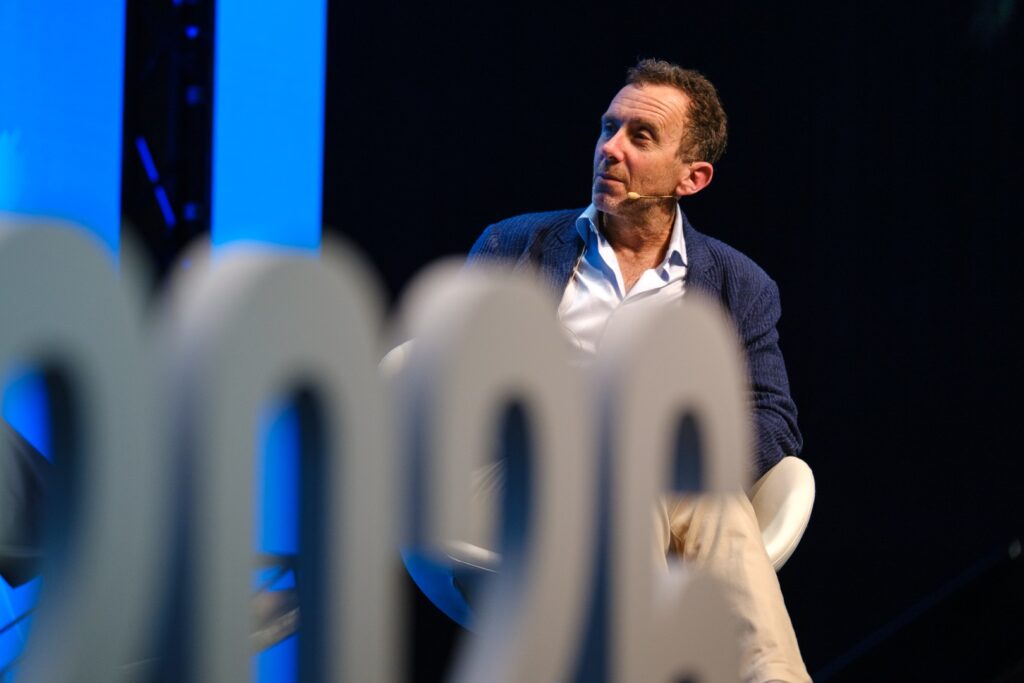
Gabriel Kra, Managing Director and Co-Founder of Prelude Ventures at Energy Tech Summit 2026
What happens as battery penetration rises
Kra put the economic problem directly. When battery penetration is low, the incremental value of the next battery is high. So a developer can afford to pay a great deal to install it. Above 40 or 50% penetration, that incremental value falls, and the affordable price falls with it. Does the proposition still drive down consumer costs and decarbonize the grid?
Plante’s answer was one word: yes. Pressed, he went further. He expects a world in which the grid runs entirely on renewables and storage, with no fusion and no nuclear required. Not in his own lifetime necessarily, but certainly in his children’s.
He also flagged a word missing from the panel title. Cost matters, decarbonization matters and speed matters. Reliability, though, matters enormously too. Whether a resource is utility-scale or distributed is secondary. What counts is whether it is affordable, reliable and decarbonized.
Two states, and what they prove about policy
Deployment is where Plante got specific, and his observation was the sharpest data point of the session.
The US has roughly 35 gigawatts of utility-scale storage in front of the meter. Almost all of it sits in California and Texas. The interesting part, he said, is that those two states have nothing else in common. Moreover, they arrived there by completely different routes.
That makes them instructive rather than anecdotal. There are different ways to reach the same deployment outcome. So the work is figuring out which policies and which incentives actually produce it.
Gregoir agreed, from a fund founded on the belief that around 90% of the technology needed already exists. Junction’s role is scaling what is there. That makes regulation the dominant variable.
His supporting example came from the Netherlands, where businesses can no longer connect to the grid, because there is too much intermittency to manage. Renewables continue to grow globally despite geopolitical disruption. More renewables mean more intermittency. In turn, that means both utility-scale and distributed solutions are needed, alongside grid enhancing technologies. His fund invests in that area too. Germany is talking a great deal about large batteries, he noted, but somebody still has to install and connect them.
Distributed or utility-scale for the next decade?
Asked which will grow faster over the next 10 years, Plante refused to choose. Both, he said. The behind-the-meter cost curve has fallen far enough that gigawatts of distributed batteries will get deployed. Meanwhile, grid operators elsewhere in the US and around the world will learn from what California and Texas did. The economics work in both cases. So it is not an economic question.
Gregoir agreed, then found a way to disagree usefully. The panel had debated beforehand what a big battery even is. In his view, many large batteries are themselves distributed assets rather than utility-scale ones. Forced toward a contrarian answer, he picked distributed over very large centralized.
Twiddy brought it back to the consumer. The question is where the value comes from and whether it persists. Combining solar with battery storage delivers a better return at household level, as it does at commercial scale. The reason any of this matters, he added, is simple. Flexing assets is what gets us to the grid we actually want.
The California lesson on getting incentives wrong
Kra offered a cautionary example from his own market. California introduced a progressive tariff structure to encourage rooftop solar, then kept it in place too long.
The policy worked, and then it overstayed. Now policy people and businesses face a harder job. They have to put batteries on those same solar roofs. Then they have to persuade those consumers to give up a highly attractive rate. Finally, they still have to create value for them and for other ratepayers.
Why Octopus worked where others didn’t
Kra asked the question the room had been circling. Why did one UK company build a large, profitable business serving many happy residential customers? At-scale success stories of that kind remain rare.
Twiddy put it down to the customer proposition. Before Octopus, companies sold you electricity. Octopus can offer electricity plus the car, leased, plus various other solutions for the home. That creates more revenue and a greater share of wallet. It also reduces the cost of servicing the customer, because the relationship exists for more than one transaction. Above all, they made something simple and attractive that went beyond what the establishment offered.
Kra pushed a more cynical reading. Perhaps Octopus simply spotted a spark spread between renewable and traditional generation, then built a clever business model on it. He reported being told, in effect, that this was a venture capitalist’s answer.
Plante’s answer started from what he invests in: people. Culture eats strategy, and Octopus has an unmistakable one. Walk into their office, he said, and everything is pink and purple, so you cannot forget where you are for a second. Their strategy of treating customers well is embedded in everything they do.
The second half of his answer was about talent, and it doubled as a comment on the whole sector. After Thomas Edison, the best and brightest went elsewhere, mostly to big tech. That has changed over the last 10 to 15 years. Now the industry attracts exceptional people, precisely because the problem is so large and so intractable. That, in Plante’s view, is what will solve it.
Who controls the flexing?
An audience member from venture capital asked the question the panel called its own next topic. Whoever owns the asset, who actually pulls the trigger? Do you optimize locally for your own house or industrial site? Or do you hand control to a DSO or someone else in the utility chain?
Gregoir had discussed exactly this shortly before with someone in Australia, a market further ahead than most. What he was told is that people who bought their assets outright did not want other parties using them. Their reasoning was that they would lose value they should have captured. That mindset appears to be shifting.
Leasing is where it clearly differs. If you effectively just have an energy tariff, the mentality changes. Those customers seem far less concerned about another party optimizing the asset. So Gregoir expects a mix. Some owners will want to capture all the value themselves, served by software and technology providers. Others will sit on leasing arrangements and want somebody else to handle it.
Kra added a US example without naming it. One company has raised a very large sum to install batteries in people’s homes behind the meter. Its bet is that it can provide the service at no cost to the homeowner and still monetize the battery attractively. Prelude is not an investor. Even so, he called it a genuinely interesting proposition, and said he is keen to see how it plays out.
Speakers at Energy Tech Summit 2026
Takeaway
Forced into a final one-word choice, the panel split. Twiddy picked utility-scale, while Gregoir and Plante picked distributed. That split matters less than what preceded it. The cost curves have crossed on behind-the-meter storage. The technology is largely in place. Moreover, the economics work at both ends of the system. So what decides where capacity actually lands is policy design. That is why America’s utility-scale storage sits in two states that agree on almost nothing else. The other deciding factor is who gets to pull the trigger on flexibility once the assets are installed. Utility-scale vs distributed energy turns out to be less about hardware than about incentives and control.
Energy Tech Summit Asia comes to Kuala Lumpur on September 29–30. There, the same question meets a region where both answers are being built at once.